



Repairing damage in an older New York home may reveal that certain work must meet current requirements. The cost of restoring damaged property and the added cost of a required code change are related questions, but they should not be treated as automatically identical.
Fire is one event that can bring those questions into focus. USFA estimates that 343,000 residential building fires occurred nationally in 2024. U.S. Fire Administration This national figure does not describe the age of affected homes or code-upgrade costs. It shows why understanding the repair process is useful before a major loss exposes parts of a building that have not been opened for years.
Ask what requirement actually applies
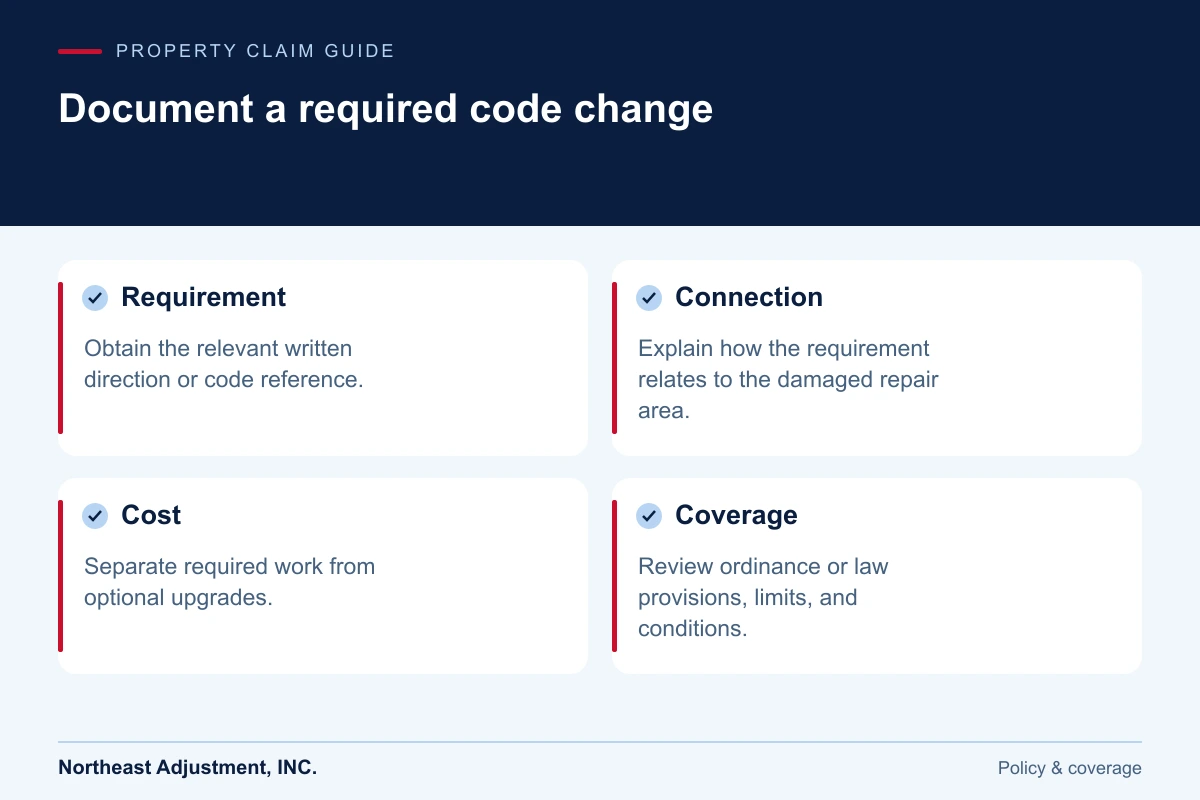
Start with the building professional or local authority responsible for the work. Request a written explanation identifying the relevant requirement, the affected location, and why it applies to the planned repair.
Avoid relying on a contractor's broad statement that “everything must be brought up to code.” The scope may depend on the work being performed, existing conditions, and local enforcement. A specific written basis is easier for the insurer and other reviewers to evaluate.
Keep permit applications, plan comments, inspection notices, and related correspondence. Do not assume that an older component is unsafe or noncompliant simply because it is old.
Find ordinance or law provisions
The NAIC's post-disaster guide explains that ordinance or law coverage can address additional costs associated with meeting current building codes after damage.
Check your declarations, forms, and endorsements for the actual coverage, limit, and conditions. Ask the insurer how the provision applies to the documented requirement. The presence of replacement-cost coverage does not by itself answer every code-related question.
Keep coverage discussion separate from the decision about whether the work is legally required. The local requirement and the insurance contract serve different purposes.
Build a code-related work file
- Written requirement or professional explanation with the relevant reference.
- Photographs and plans showing the affected repair area.
- A contractor estimate separating base restoration from the additional work.
- Permit and inspection records.
- The applicable policy form and insurer's written response.
- Change orders explaining newly required tasks.
If a requirement affects an undamaged area, ask why and request documentation of that connection. Do not assume the policy covers every extension of work beyond the visibly damaged room.
Separate required changes from chosen improvements
A required electrical change and a homeowner's decision to add decorative lighting should have separate estimate entries. Both may be part of the same construction project, but they do not have the same claim basis.
Likewise, choosing a more expensive finish for convenience or preference should not be presented as a code mandate. Accurate separation helps the contractor explain the project and the owner budget for personal choices.
Preserve estimate versions when requirements become clearer. A revised scope should identify the new information rather than erase the earlier record.
Consider an older-home repair
In a hypothetical New York home, a fire repair requires opening a wall near the kitchen. The contractor identifies an electrical issue and seeks direction from the appropriate authority before proceeding.
The owner obtains the written requirement, an itemized cost, and the relevant policy endorsement. Those records allow a focused discussion about the required work. They do not guarantee coverage, establish a universal rule for older homes, or justify unrelated renovations.
This is also why early coordination matters: waiting until the final invoice to identify a code-related change can leave important questions unresolved.
Common questions
Does every older home need full modernization after a claim?
No such assumption should be made. The actual damage, repair scope, existing conditions, and applicable requirements need review.
Is a permit fee the same as code-upgrade coverage?
No. A permit is part of the repair process; coverage for additional required work is a separate policy question.
Who should explain an unexpected requirement?
Request clarification from the relevant building professional or authority and provide that record to the insurer.
Read comparing repair estimates to organize the costs. Contact Northeast Adjustment for help presenting documented code-related questions in a property claim.