

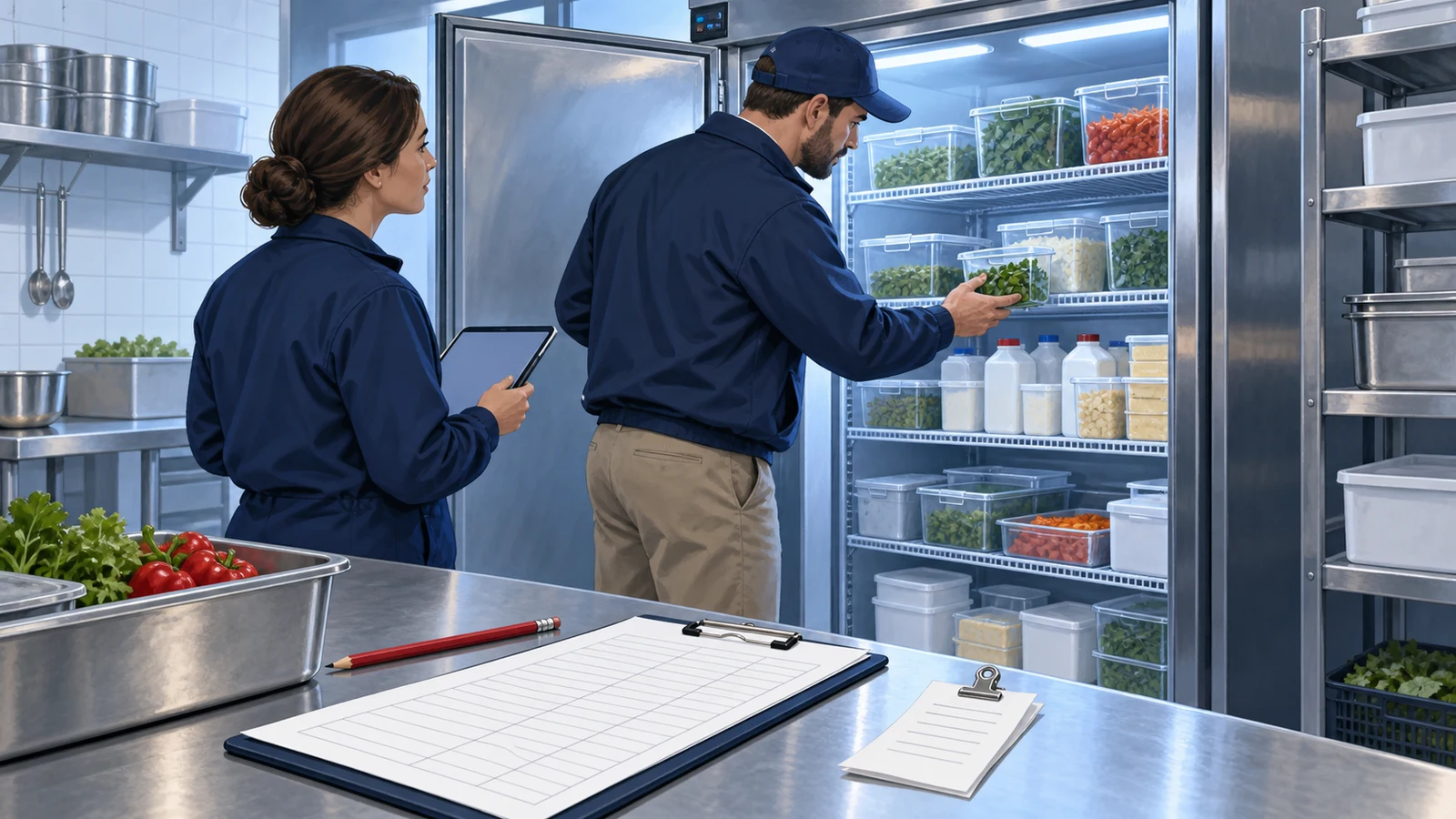
When restaurant refrigeration fails, food safety comes first. The claim record should support prompt, appropriate decisions about stock, not keep unsafe food on site while everyone waits for an inspection.
SBA's 2025 Connecticut profile lists 12,565 small accommodation and food-service businesses in its 2022 data. U.S. Small Business Administration Office of Advocacy The figure counts Connecticut firms with fewer than 500 employees, including nonemployers; it is not a spoilage-loss statistic. It reflects how many local businesses operate in a sector where equipment, inventory, and service interruptions can be closely connected.
Record when the problem was discovered
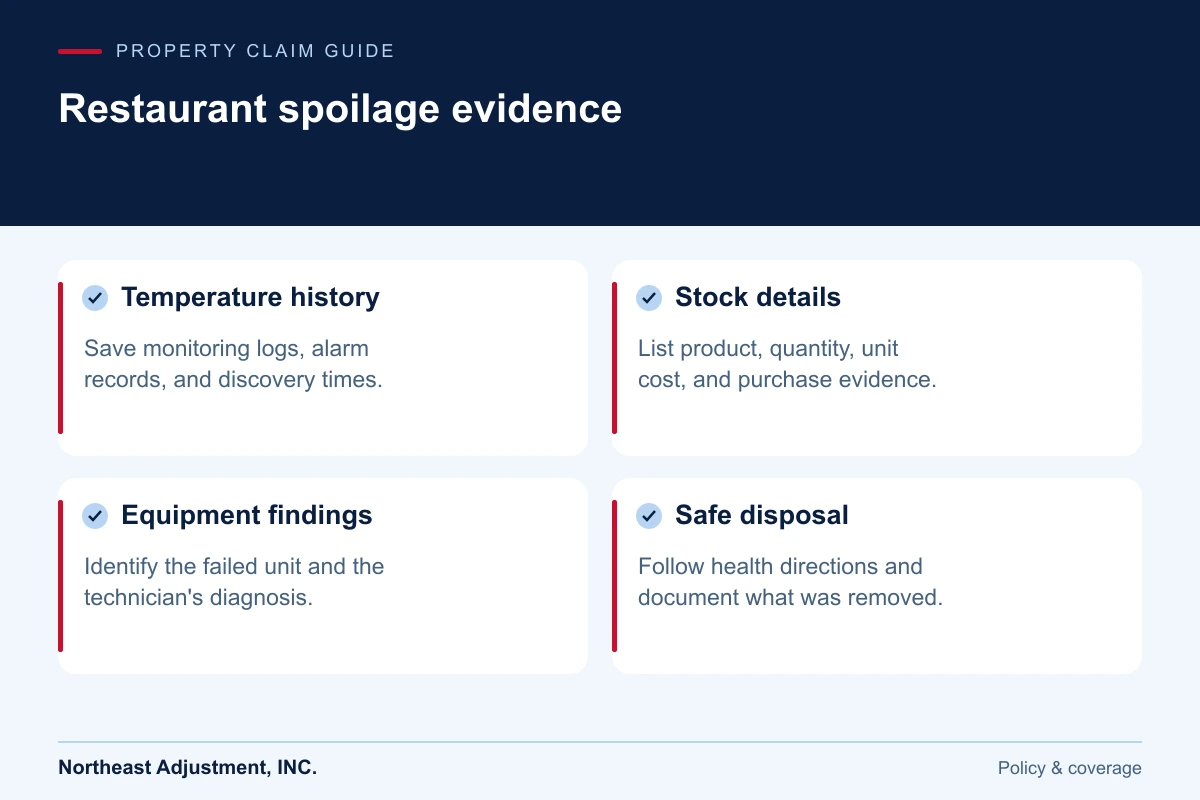
Save the discovery time, available temperature logs, alarms, and staff observations. Record whether the unit lost power, displayed an error, or appeared to run without maintaining temperature. Do not diagnose the failure from one symptom.
Follow the applicable health authority's requirements and your food-safety procedures. The FDA's outage and flood guidance emphasizes safe food handling and warns against judging safety by tasting. Commercial operators also need to follow the rules that apply to their business.
Document what is practical without delaying necessary disposal. A photograph and a contemporaneous stock list are more useful than retaining unsafe food.
Obtain a technical equipment report
Ask a qualified technician to identify the unit, make, model, serial number, and observed fault. Request an explanation of testing, repair performed, and any limitation on identifying when the failure began.
Preserve service history and warranty documents. If a component is replaced, ask about safe retention or photographs before disposal. Do not remove or alter parts yourself in an attempt to create proof.
Equipment repair, spoiled stock, and lost business activity may involve different provisions. Review the commercial policy and endorsements rather than assuming a refrigeration failure makes every resulting expense payable.
Build a stock list with support
- Product name, brand or supplier, and package size.
- Quantity affected and the method used to count it.
- Purchase invoice or other reliable cost record.
- Storage unit and location at discovery.
- Temperature or handling information available.
- Disposal date, method, and relevant health or professional direction.
Distinguish unopened stock from prepared food where your records allow. For prepared items, preserve recipe costing or other accounting support instead of assigning an unsupported retail selling price.
If some stock was safely transferred and retained, record it separately. A full inventory at the start of the day is not automatically the quantity lost.
Keep the cause and costs connected
Notify the insurer promptly and ask about spoilage, equipment breakdown, utility interruption, or other potentially relevant provisions. New York DFS's small-business guidance identifies equipment breakdown and other endorsements among commercial coverage options. Their presence and terms must be checked in your contract.
Ask which limit, deductible, and documentation requirements apply. Keep technician charges, disposal costs, replacement purchases, and any income-related records in separate categories.
A hypothetical Connecticut café
Suppose a café manager discovers that a walk-in unit did not maintain temperature overnight. Staff preserve the alarm history, contact a technician, and follow health guidance on affected food.
The inventory list identifies what was inside the unit and which items were safely moved elsewhere. Supplier invoices support quantities and purchase costs. The technician's report describes the equipment finding without guessing at an exact failure time.
The café can present a coherent record, while the insurer evaluates the cause and relevant policy provisions. This scenario is illustrative and does not promise spoilage coverage.
Common questions
Should I keep spoiled food until the adjuster comes?
No. Follow food-safety requirements. Document safely and retain the records explaining what was discarded and why.
Can the claim use menu prices?
Do not assume retail selling prices are the correct valuation. Ask how the policy values stock and keep actual cost evidence.
Does fixing the refrigerator prove the cause of all spoilage?
The service report is part of the evidence. Temperature history, timing, stock condition, and policy terms still matter.
Read business interruption financial records for a separate documentation task. Contact Northeast Adjustment to discuss organizing restaurant property-loss records.