


Water damage in a condominium can involve your belongings, interior finishes, shared systems, and another unit. Understanding which policy addresses which interest requires more than knowing where the leak began. The unit policy, association insurance, governing documents, and actual damage all matter.
A contents inventory remains useful even when the building has a master policy. In a 2023 Triple-I/Munich Re survey, 47% of homeowners said they had prepared an inventory of their possessions. Insurance Information Institute / Munich Re That United States survey describes homeowners' self-reported preparation. An association's records generally will not identify every item you own inside your unit.
Gather both sides of the insurance picture
Locate your complete unit-owner policy and endorsements. Ask the building manager or association for relevant master-policy information and the governing provisions used to allocate insurance and repair responsibilities.
The New York DFS homeowners and tenants guide describes unit-owner insurance and association coverage as addressing different property interests. The actual documents need review; broad labels such as “walls in” do not settle every fixture or finish.
Notify your insurer promptly and follow the association's reporting process. Do not wait for the board to finish investigating before making your own report.
Map the damage by property category
Create a list of affected unit rooms and any visible common-area concerns. Identify personal belongings separately from flooring, cabinets, walls, and installed equipment.
Record improvements made by current or prior owners where known. Save renovation agreements, invoices, and photographs. The treatment of an upgraded kitchen can differ from assumptions based on an original building layout.
Ask qualified professionals to document the source and path of water. A leak originating in another unit does not automatically decide legal responsibility or determine which insurer pays each expense.
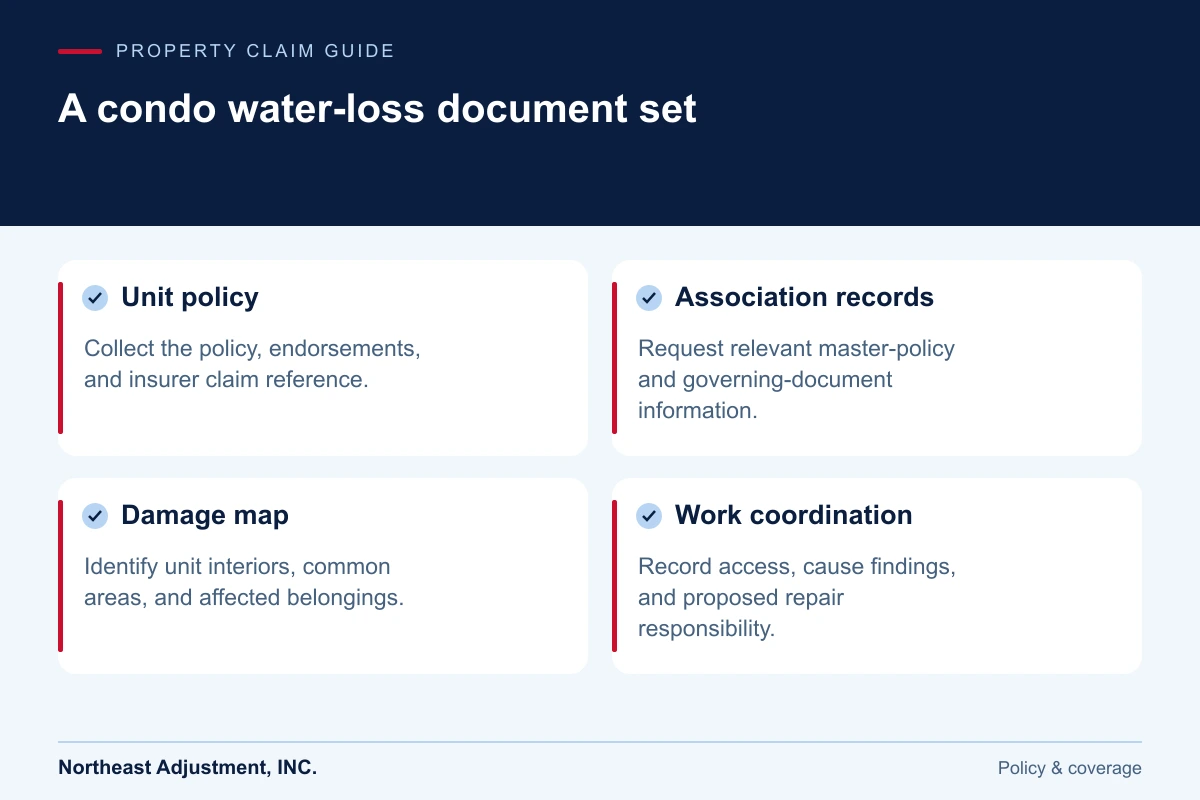
A useful condo coordination checklist
- Unit policy, endorsements, and claim contact.
- Relevant association insurance and governing documents.
- Source report, room photographs, and a damage map.
- Ownership and renovation records for affected components.
- Contents inventory with item locations and evidence.
- Written access arrangements and proposed repair responsibilities.
Keep communications clear about which unit or common area is being discussed. “The bedroom ceiling in Unit 3B” is easier to follow than “the ceiling below the leak.”
Ask about deductibles and assessments precisely
If an association deductible or assessment is mentioned, request the written basis, amount, and allocation explanation. Ask your insurer whether any provision in your unit policy may apply.
Loss-assessment coverage should not be assumed to pay every charge from an association. Its terms, limits, exclusions, and the nature of the assessment need review. Similarly, an association's decision to perform work does not automatically establish your policy's payment obligation.
Questions involving governing-document interpretation or legal responsibility may require the appropriate legal professional. Keep that separate from gathering the physical damage evidence.
A hypothetical stacked-unit leak
Suppose water from an upper unit reaches a lower apartment and a common hallway in a New York condo building. Management arranges source investigation and necessary protection. The affected owner documents furniture, flooring, and ceiling conditions individually.
The association and owner exchange the relevant reports and identify which contractor will access each area. The owner's renovation records show what was installed in the affected room. Those documents help the insurers evaluate their respective questions without assuming that all wet property belongs in one claim.
This example illustrates coordination, not a particular policy interpretation or outcome.
Keep the repair sequence visible
Before permanent work covers evidence, coordinate inspection opportunities and preserve photographs. Ask for a scope showing which party is arranging each task. Check that removal, drying, and restoration are not omitted or counted twice.
If walls are opened and more damage appears, document the newly visible condition and update the relevant contacts. Preserve the earlier estimate so the change can be explained.
Common questions
Should I report the loss if management says the master policy will handle it?
Promptly discuss the event with your own insurer. Management's expectation is not a substitute for your policy's reporting requirements.
Does the neighbor's leak make the neighbor automatically responsible?
No. Source, responsibility, and coverage are separate questions requiring the actual facts and documents.
See basement water source investigation for the importance of cause records. Contact Northeast Adjustment to discuss organizing a condo property claim.