
New Jersey Fallen Tree Insurance Claims

A fallen tree claim in New Jersey is rarely one bill: removal, roof repair, fencing, and the question of whose tree it was all arrive together. Northeast Adjustment, INC. takes New Jersey tree losses from the first photos of the trunk to the settled claim, and the first review costs nothing.

Icon check mark
Tree strikes on roofs, fences, and service lines statewide
Icon check mark
The tree and impact point recorded before removal
Icon check mark
Free claim review for New Jersey tree losses
A+ Rating
on BBB
Better Business Bureau
Over 50+ Years of
Combined Expereince
Free consultation
Our Process
1
We personally inspect your property and establish the true value of your loss

We walk the property with you, document every affected area, and evaluate inventories, so your loss is on paper before the insurance company puts a number on it.

2
We arrange your temporary housing while you are out of your home

We take over your hotel bill and actively look for a house or apartment rental. Families are often out of their home for a year, this is the in-between living while the claim is settled with the insurance company.

3
We serve as your direct liaison with the insurance company

Every call, inspection, and negotiation goes through us. You never have to argue with an insurance adjuster or chase paperwork on your own.

4
We’ll ensure you receive the Maximum compensation

We negotiate the settlement against your full documented loss, not against the first offer the insurance company puts in front of you.

Request free claim review
Why fallen tree claims in New Jersey are different

Forests cover roughly 45 percent of New Jersey, about 2.1 million acres, inside the most densely populated state in the country. Few places hold this much mature canopy directly above this many roofs, and the results show up every storm season as trunks and limbs on houses, garages, fences, and service lines.

The weather supplies the trigger. A typical year brings 25 to 30 thunderstorms to most areas of the state, concentrated in summer, with the lightning and hard wind gusts that snap or uproot trees. At the other end of the calendar, nor'easters and snow events that flip to rain load limbs with ice and wet, heavy snow until they give way.

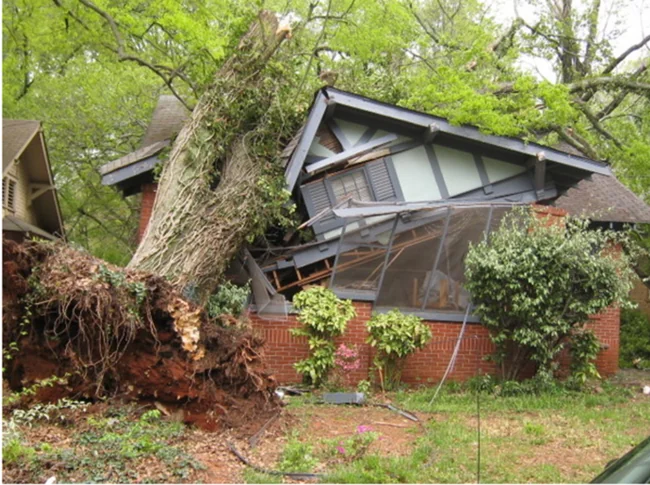
The scene is the most perishable part of the claim. Removal crews often arrive within hours, and once the trunk is sectioned and hauled off, everything rests on the record made first: the whole tree where it lies, the point where it met the building, and the spread of debris around it, all photographed before a saw runs.

Our fallen tree claim guide walks through the coverage caps, negligence arguments, and removal-cost fights that follow every tree loss. This page stays on the New Jersey side: the weather behind these losses, the state's claim clocks, and how we run the file.

Fallen tree losses across New Jersey

Four situations that turn a downed New Jersey tree into an insurance claim.

A summer storm drops an oak through the roof deck

Lightning or a downburst can put a mature tree into the attic in seconds, with rain still falling behind it. The loss is bigger than the tree: sheathing, framing, ceilings, insulation, and whatever the water reached below belong in the same claim.

A loaded limb gives out in a winter flip

A storm that starts as snow and ends as rain can leave a limb holding ice and waterlogged snow at once. When it drops onto a porch roof or a fence line, record the storm date; what brought the limb down is usually the first coverage question.

The trunk takes the service line down with it

A tree that snaps the line to the house can leave refrigerators dead for days. Whether spoiled food or a shop's lost stock rides along depends on the policy and its spoilage or power-interruption provisions, so list and photograph the losses before disposal.

One tree, two lots

On lots as tight as New Jersey's, a single trunk can cross a boundary and damage two properties at once. Each owner generally starts with their own policy, and sorting which coverage answers for which damage is part of the adjusting work.

New Jersey deadlines that matter

Report the loss and N.J.A.C. 11:2-17 starts two 10 working day clocks at once, one for the insurer's acknowledgment and one for opening its investigation, but a trunk cannot wait on a roof for either, so the dated record made before removal is what that investigation ends up leaning on. Your letters run on a clock of their own: 10 working days for the carrier to respond to each one. Decisions carry claim-type caps too, and an insurer that cannot meet one has to tell you in writing why the file is delayed, then keep the updates coming. Every timeframe is collected in our New Jersey claim deadline guide.

How we handle a New Jersey fallen tree claim

Licensing for this work runs through the Department of Banking and Insurance, and the adjuster's client is the policyholder, never the carrier. We handle New Jersey tree losses out of our Forest Hills, Queens office at every step: we photograph the trunk and strike point, price removal alongside structural repair, assemble the file, and negotiate until the number reflects the documented loss. Everything else we do for New Jersey policyholders is on the state page.

A downed tree rarely stays a single claim. Wind strong enough to fell it often leaves storm damage elsewhere on the property, rain follows the break inside as a water damage claim, and dampness left in the cavity can surface later as mold.

FAQs
My neighbor's tree landed on my New Jersey property. Whose insurance pays?
How fast should I document a tree loss during New Jersey's thunderstorm season?
The removal estimate is several times the tree limit in my policy. Do I just absorb the difference?
The insurer says the tree was rotten and denied the claim. Is that final?
Still have questions?
Get in touch with our friendly support team.
Get in touch
Our loyalty is to you, not your insurance company.
Thank you! A team member will be in touch shortly.
Oops! Something went wrong while submitting the form.
Don't settle for less, maximizing your compensation is our priority.