



Replacement cost and actual cash value describe different ways of valuing damaged property. Understanding them helps explain why a repair estimate, an initial payment, and a final payment may show different amounts.
Good item records matter whichever approach applies. In a 2023 Triple-I/Munich Re survey, 47% of homeowners said they had prepared an inventory of their possessions. Insurance Information Institute / Munich Re This United States survey reflects self-reported inventories. Knowing an item's model, age, condition, and characteristics can make a valuation discussion more specific than a line reading simply “sofa” or “television.”
Start with comparable property
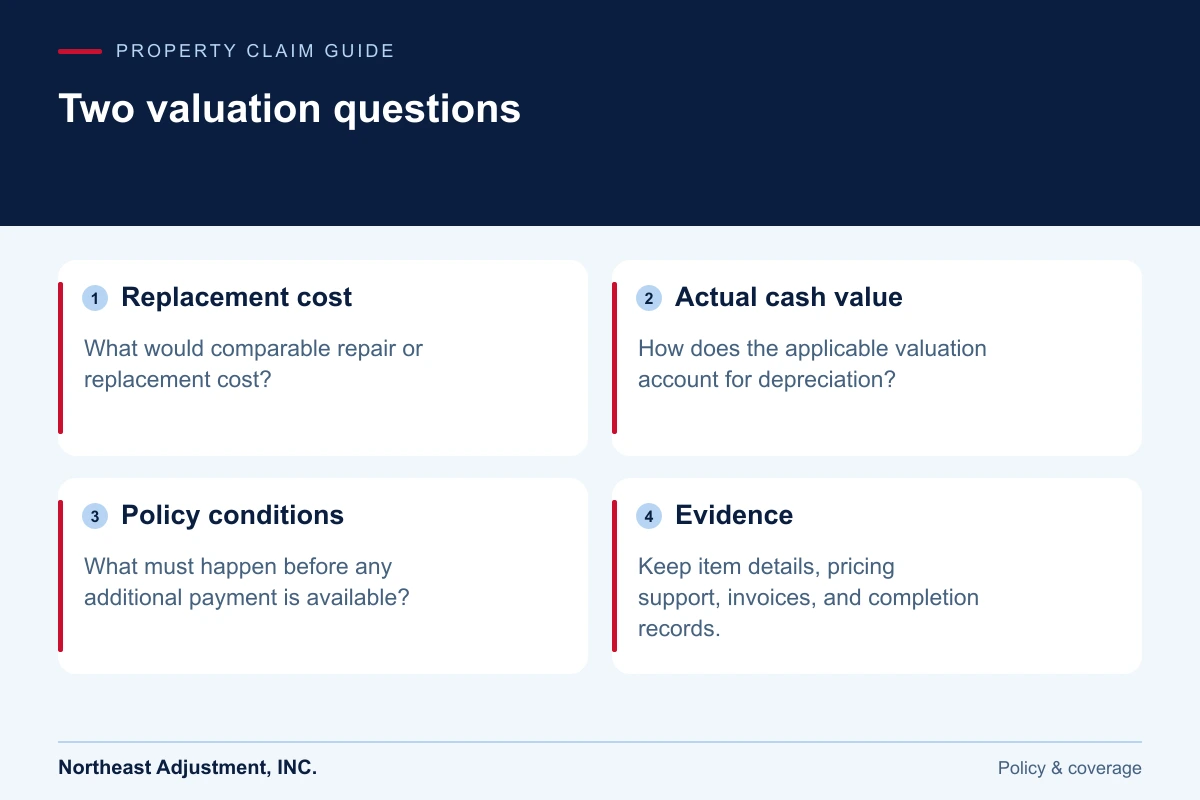
Replacement cost generally concerns the cost to repair or replace covered property with comparable materials or items under the policy's terms. It is not an automatic allowance for an upgrade, a larger appliance, or a complete redesign.
For a building component, the estimate may include materials and the work needed to install them. For personal property, the relevant comparison should reflect the damaged item's features and quality. Save product descriptions rather than relying only on a screenshot of a price.
The Connecticut Insurance Department's claims guide explains replacement cost and actual cash value, including how depreciation can affect an initial payment.
Understand what depreciation represents
Actual cash value commonly incorporates depreciation. The precise method and applicable rules need to be checked for the property and policy involved. Age may matter, but condition and other supported information can also be relevant.
Ask for the basis of a depreciation amount that is unclear. Do not assume that every item is reduced by the same percentage or that a sample rate in a consumer guide applies to your possessions.
For a simplified illustrative example, suppose the supported replacement cost is $2,000 and the applicable depreciation adjustment is $500. The resulting figure before a deductible or other adjustments would be $1,500. This is arithmetic only, not a typical rate or an estimate of anyone's payment.
Check when additional payment may become available
Some replacement-cost provisions require actual repair or replacement and supporting proof before additional amounts are payable. Ask what documents are needed, which deadline applies, and how the insurer treats different parts of the claim.
Do not assume all depreciation is recoverable. Read the valuation provision and claim explanation. A policy might treat the building and contents differently, and limits or exclusions can affect the result.
Keep written instructions about replacement requirements. If circumstances make a stated deadline difficult, raise the issue promptly rather than assuming it will be extended.
Records that support the discussion
- Pre-loss photographs, inventory descriptions, purchase dates, and known condition.
- Model numbers, materials, sizes, and features of damaged property.
- Itemized repair estimates and comparable replacement information.
- The insurer's valuation calculation and explanation of depreciation.
- Invoices, payment records, and completion photos for work or purchases made.
Match each replacement invoice to the original inventory entry. If you choose a more expensive upgrade, identify the difference clearly so your personal choice is not confused with the supported claim amount.
A hypothetical older-home example
Suppose water damages wood trim and a freestanding bookcase in a Pennsylvania home. The trim requires a repair scope addressing material and installation; the bookcase requires its own contents description.
The owner requests explanations of both valuation calculations instead of assuming that the same rate or payment conditions apply to each. The bookcase's old photograph and the contractor's trim measurements support different questions. The example illustrates the process without deciding whether the water event or particular repairs are covered.
Common questions
Does actual cash value mean what I could sell the item for today?
Do not assume that a resale listing is the policy's valuation method. Ask how the insurer calculated actual cash value for the item.
Must I buy the exact same model?
Ask about comparable replacement requirements and what happens if the original is unavailable. Keep evidence of features and availability before making a decision based on expected reimbursement.
Can I question depreciation?
You can request the calculation and provide accurate evidence about the item's condition or characteristics. That does not guarantee a revised amount.
Our deductible guide explains a separate adjustment. Contact Northeast Adjustment for help organizing the valuation questions in a property claim.