


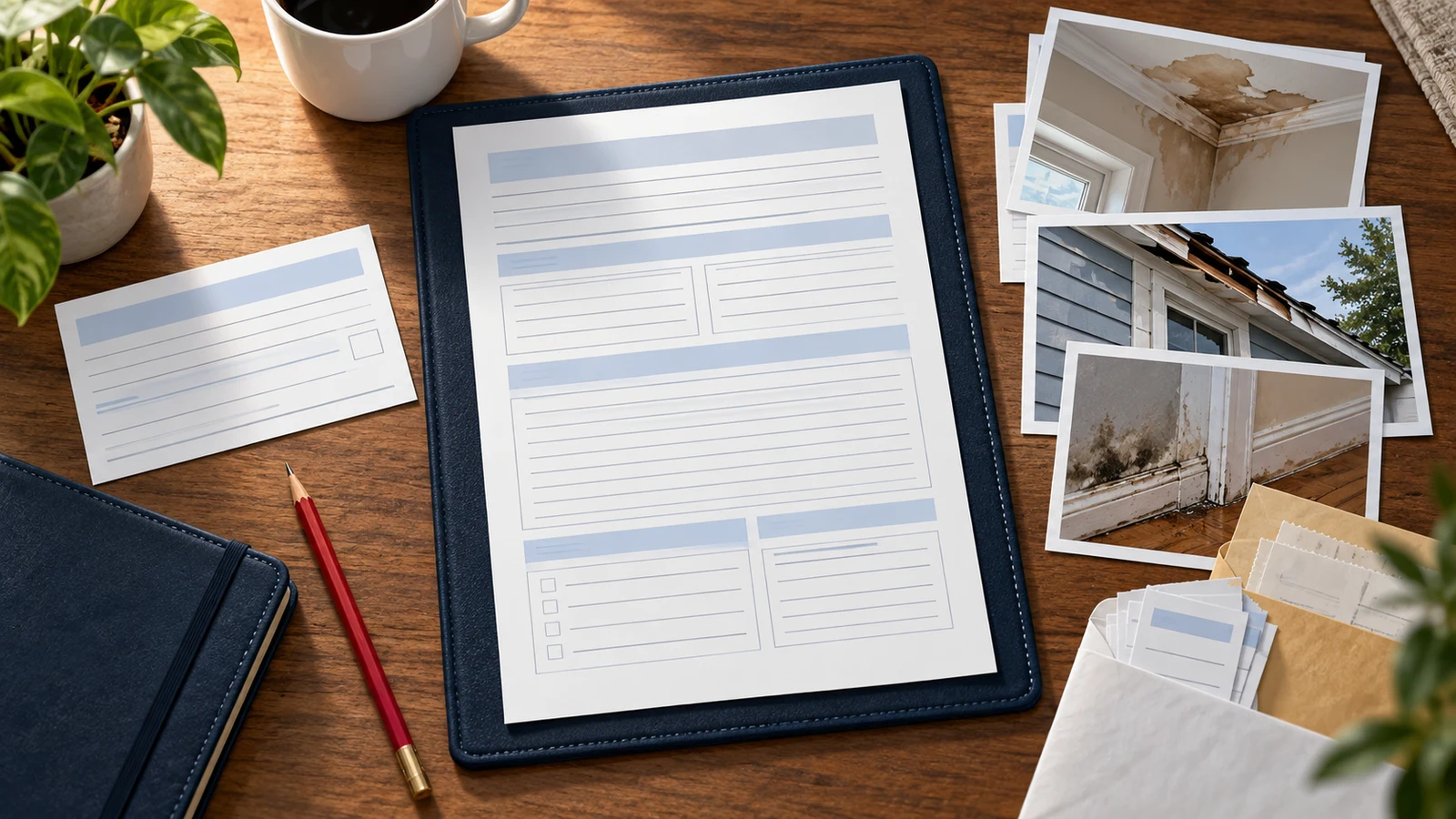
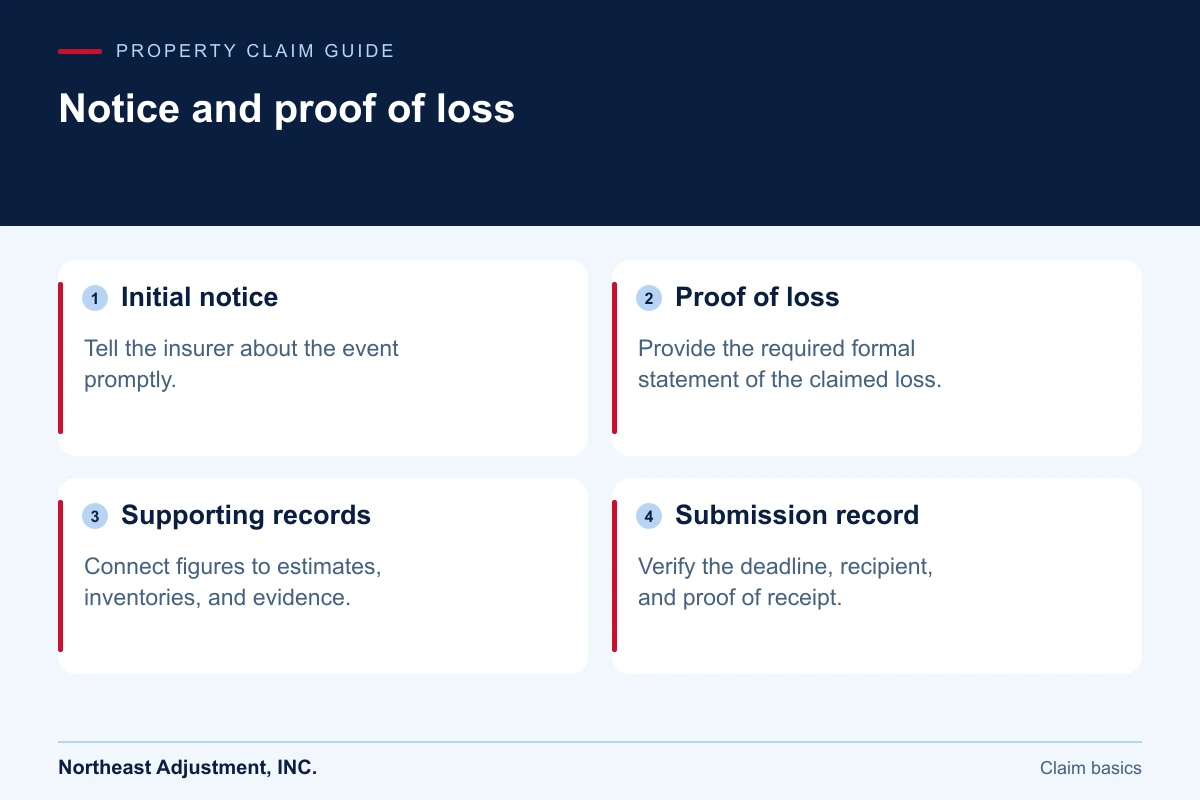
Calling the insurer tells it that an event occurred. A proof of loss may be a separate formal statement describing what you are claiming. Receiving a claim number or having an adjuster visit does not necessarily satisfy that additional requirement.
Flood claims make the distinction especially important in the Northeast. Pennsylvania's Insurance Department reports that destructive flooding has occurred in all 67 counties. That is a cumulative historical statement, not an annual count or a forecast. It is a reason for property owners to understand the documents their particular insurance requires. Pennsylvania flood information
Identify the policy and the requirement
Ask whether a proof of loss is required, which form to use, who must sign it, and where it must be delivered. Request the applicable policy language and any written instructions.
Homeowners, commercial, and flood policies may have different requirements. Do not assume that a form used for one claim is appropriate for another.
For example, FEMA's NFIP claims manual describes a signed and sworn proof of loss under the Standard Flood Insurance Policy and its submission requirements. NFIP rules should not be generalized to every property policy. Extensions or waivers must be verified for the actual loss.
Review the form against your records
A proof of loss can ask about the insured, property, event, interests in the property, insurance, damage, and amount claimed. Read each field rather than treating it as a routine administrative signature.
Check names, address, policy number, date information, and figures. If you do not know an answer, ask how to address the uncertainty accurately. Do not fill a gap with a guess that later appears to be a sworn fact.
In an illustrative Pennsylvania flood claim, a homeowner's building estimate changes after damaged material is removed. Before signing a form, the owner should understand which estimate the stated amount represents and how any additional findings should be handled.
Make the claimed figures traceable
An organized package lets a reviewer follow an amount to its support. Depending on the policy and request, that may include:
- A detailed building estimate.
- A damaged-contents inventory.
- Photos tied to rooms or items.
- Emergency-work invoices.
- Ownership and value records.
- Explanations of revisions or disputed items.
A contractor's total is not automatically the correct number for every form field. Ask about deductibles, prior payments, limits, and valuation terms rather than performing unexplained arithmetic.
Keep the estimate version and date visible. If the insurer or adjuster prepared the form, review it just as carefully as a form you completed yourself.
Track delivery as a separate task
Create a calendar entry for the actual requirement and an earlier reminder to gather missing records. Confirm who receives the form and whether a particular delivery method is required.
Keep the signed copy, attachments, transmission record, and receipt confirmation. Ask promptly if the insurer identifies a defect or missing information. A saved draft on your computer does not establish submission.
If the deadline may be difficult to meet, seek qualified assistance immediately and request any available extension through the appropriate process. Do not assume that a pending estimate, an unanswered email, or an adjuster's involvement automatically extends the time.
Resolve disagreements before signing
If you disagree with the amount, description, or wording, explain the issue and obtain guidance. A proof of loss can have legal significance. Questions about preserving rights, disputed wording, or the effect of signing should go to a qualified attorney when necessary.
Do not alter a prepared form casually or sign an inaccurate statement because someone says it can always be fixed later. Ask how revisions or supplemental information should be made under the applicable policy.
Common questions
Is a proof of loss the same as the repair estimate?
No. An estimate describes proposed work and cost. A proof of loss is a formal claim document that may rely on that estimate.
Does signing mean I agree with everything the insurer says?
The effect depends on the document and circumstances. Read it and obtain advice about wording you do not understand.
Can an adjuster help prepare it?
Often assistance is available, but you should verify the information and your own obligations before signing.
Our claim library explains other documentation steps. Contact Northeast Adjustment to discuss organizing the supporting records and questions for your property claim.