



Business interruption coverage, also called business income coverage, raises a different set of questions from a repair estimate. The building record explains physical damage. The financial record helps explain how a qualifying interruption affected operations under the policy.
SBA's 2025 New York profile lists about 2.4 million small businesses. U.S. Small Business Administration Office of Advocacy The profile's business counts draw on 2022 Census datasets and include firms without employees. This is business context, not a count of claims or closures. For a small New York operation, organized financial records can make a difficult interruption more understandable.
Check the trigger before calculating a total
Locate the business income provisions, endorsements, limits, and any waiting period or restoration-period language. A decline in sales alone does not establish coverage. The cause, damage, suspension of operations, and policy terms need review.
The NAIC's business interruption overview describes the coverage in connection with covered events and suspended operations. Different extensions may address different situations, so ask the insurer which provision is being evaluated.
Report the loss promptly and request the financial document list. Ask how the insurer wants the information organized and who will review it.
Establish the normal operating picture
Gather profit-and-loss statements, sales reports, tax records, payroll, and expense ledgers for the requested periods. Include records that explain seasonal changes rather than choosing only your strongest month.
For a business preparing for autumn events or holiday demand, preserve bookings, purchase orders, and documented operating plans that existed before the loss. Distinguish a supported expectation from a new forecast created afterward.
If the business recently changed hours, products, or locations, explain that history. Comparisons are more useful when the reviewer understands why the prior period may not be directly comparable.
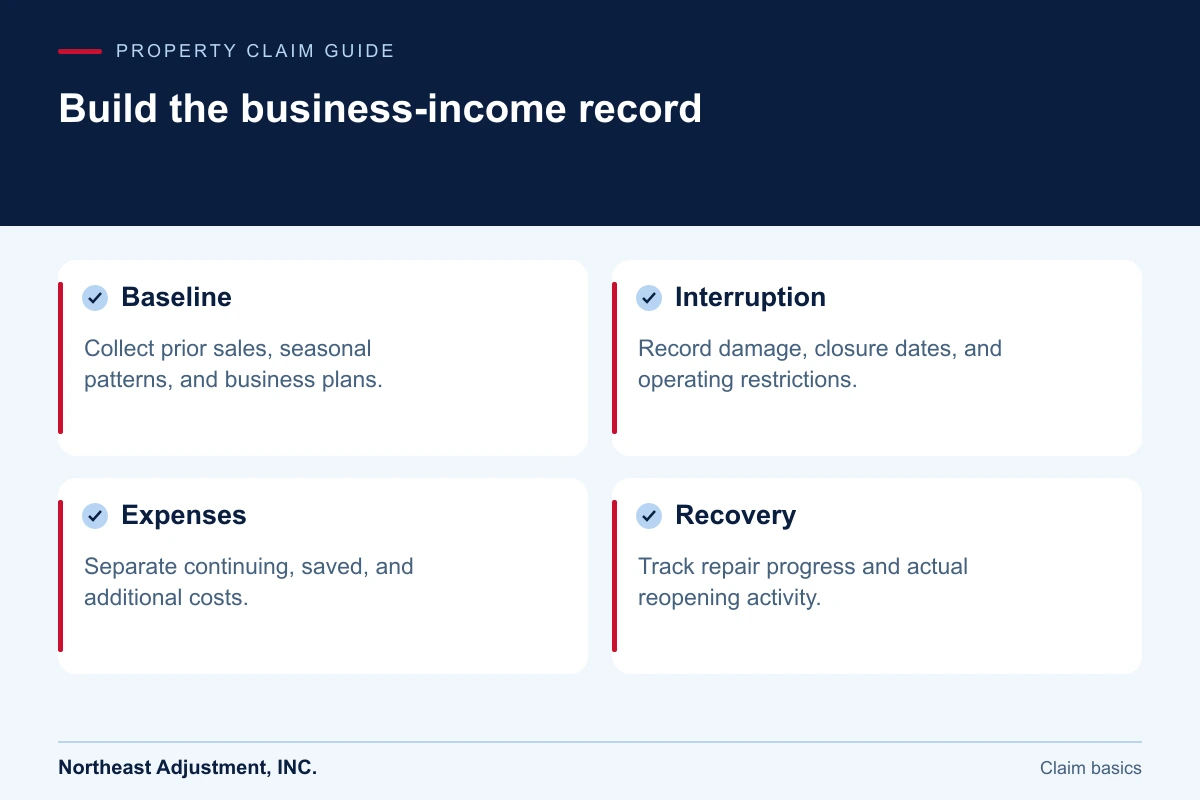
Keep separate financial categories
- Revenue records: Daily or weekly sales, invoices, canceled orders, and actual activity during the interruption.
- Continuing expenses: Rent, payroll, utilities, and other costs that continued, subject to the policy's treatment.
- Saved expenses: Costs that stopped or decreased while operations were reduced.
- Additional costs: Temporary premises, extra transport, or other claimed expenses, with reasons and invoices.
- Recovery records: Repair milestones, inspections, staffing changes, and reopening dates.
Avoid treating gross lost sales as the final claim amount. The policy's calculation may require consideration of expenses and other adjustments. Work with your accountant where financial classifications need explanation.
Connect the numbers to actual events
Maintain a closure log showing when the business stopped, partially resumed, or operated elsewhere. Save official restrictions, repair schedules, contractor updates, and management decisions.
Explain why a specific activity could not continue. “Front sales area inaccessible during electrical work” is more useful than a broad statement that business was slow. If some sales continued online or from another location, include them accurately.
Keep physical damage invoices separate from business income and extra expense records. A cost should not be counted twice under different headings.
A hypothetical neighborhood retailer
Imagine a Queens retailer whose stockroom and electrical area are damaged by a covered cause still under insurer review. The shop closes, then resumes limited pickup service while repairs continue.
The owner gathers prior sales patterns, actual pickup revenue, employee hours, and repair updates. They identify canceled orders and expenses that did not continue. The record reflects both the interruption and the business activity that remained.
This is an illustrative documentation example. It does not establish the trigger, restoration period, or amount payable under a particular policy.
Common questions
Does every businessowners policy include the same income coverage?
No. Review the actual form and endorsements, including limits and conditions.
Can I use estimates when records are unavailable?
Label estimates clearly and explain the basis. Seek replacement records from accounting systems, banks, suppliers, or advisers rather than inventing exact figures.
Does reopening end every coverage question?
Ask how the policy defines the relevant period and any applicable extension. Actual reopening records remain important even when questions continue.
Our commercial kitchen fire guide covers related physical records. Contact Northeast Adjustment for help organizing a commercial property's claim documentation.