



An insurance estimate may show replacement cost, actual cash value, and depreciation on the same page. If part of the depreciation is described as recoverable, ask what must happen before the insurer considers paying it. The label alone does not mean an automatic check will arrive when the contractor leaves.
Good item records make this easier. In a 2023 Triple-I/Munich Re survey, 47% of U.S. homeowners said they had prepared an inventory of their possessions. That self-reported national statistic highlights why identifying damaged and replacement items can become difficult after a loss. Triple-I inventory survey
Read the payment explanation first
Replacement cost and actual cash value describe different valuation approaches. Depreciation reflects a reduction in value associated with factors such as age and condition. The policy determines how these concepts apply to the building and its contents.
The Connecticut Insurance Department's post-disaster guide explains these terms and the role of repair or replacement. Ask the insurer to identify which amounts in your estimate are potentially recoverable and which are not.
Do not assume the building and every belonging have the same settlement terms. Endorsements and item-specific provisions can affect the calculation.
Follow one item from estimate to completion
Consider an illustrative New York homeowner replacing damaged flooring after a covered water loss. The estimate describes a particular room and quantity. The final contractor invoice should make clear what flooring was installed, where, and at what cost.
If the owner upgrades the material or expands the work into an undamaged room, identify that separately. A larger invoice does not by itself establish that the insurer owes the full difference.
For belongings, connect the replacement receipt to the original inventory item. Include the item description, model when relevant, receipt, delivery details, and any requested evidence. Avoid combining several unrelated purchases into one unexplained total.
Build a submission packet
Organize the material in the same order as the insurer's estimate:
- Estimate item or room reference.
- Description of the completed repair or replacement.
- Contractor invoice or purchase receipt.
- Payment evidence where required.
- Dated completion photographs.
- Any explanation of changes, credits, or unresolved work.
Ask what documents are necessary rather than sending every record you own. If a document is unavailable, explain why and ask what alternative evidence will be considered.
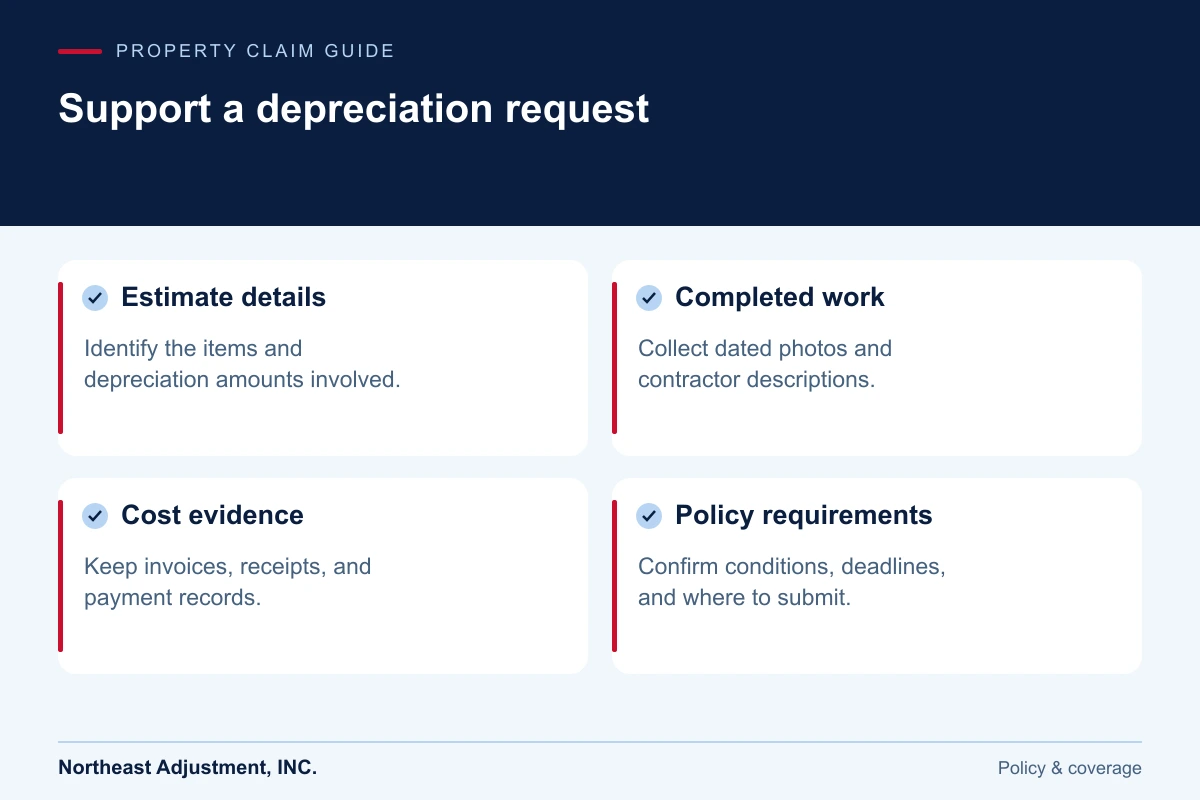
Keep originals and a copy of the exact packet submitted. If you later correct an invoice or replace an attachment, label the updated version so the reviewer can see what changed.
Check conditions and timing
Ask when the policy requires repair or replacement and when supporting documents must be submitted. Different policies can use different conditions. Do not borrow a deadline from a friend's claim or assume an ongoing conversation extends yours.
If a supplier delay or contractor availability issue may affect completion, notify the insurer before the relevant deadline and request written guidance. Do not rely on silence as approval of an extension.
A partial completion may raise questions about payment for the finished portion. Ask how that is handled and what remains necessary for the rest. Never state that unfinished work is complete just to trigger a payment.
Understand the arithmetic without assuming an outcome
For illustration only, an estimate might show $10,000 in replacement cost and $2,000 in depreciation before a deductible and other adjustments. That does not establish that $2,000 will always be released later.
The actual amount may depend on eligible costs, completed work, limits, prior payments, and policy conditions. Ask for an itemized explanation of the additional payment or any difference from the amount you expected.
If the disagreement concerns the depreciation applied initially, gather age, condition, maintenance, and product records. That is a different question from proving that replacement has now occurred.
Common questions
Will an order confirmation be enough?
Ask the insurer. An order, delivery, installation, and paid invoice establish different stages.
Can I replace an item with a different model?
Check the policy and insurer's requirements. Keep specifications that explain the relationship to the damaged item.
What if I cannot afford to finish repairs immediately?
Raise the issue promptly and ask about available claim-payment arrangements. Do not assume the policy's conditions disappear.
See our claim resources for related valuation topics. Northeast Adjustment can discuss how to organize the estimate and completion evidence for your claim.