



Seeing your mortgage company's name on an insurance check can be surprising, especially when a contractor is waiting for a deposit. It commonly reflects the lender's financial interest in the property. Start by asking your mortgage servicer for its written instructions for handling repair proceeds.
Winter repairs are a real regional concern: NOAA recorded 21 billion-dollar winter-storm events affecting New York during 1980–2024. Each event qualified based on its total U.S. losses, not New York-only damage. After such damage, the insurance claim and the process for releasing repair money can move through different steps. NOAA New York record
Find the right department
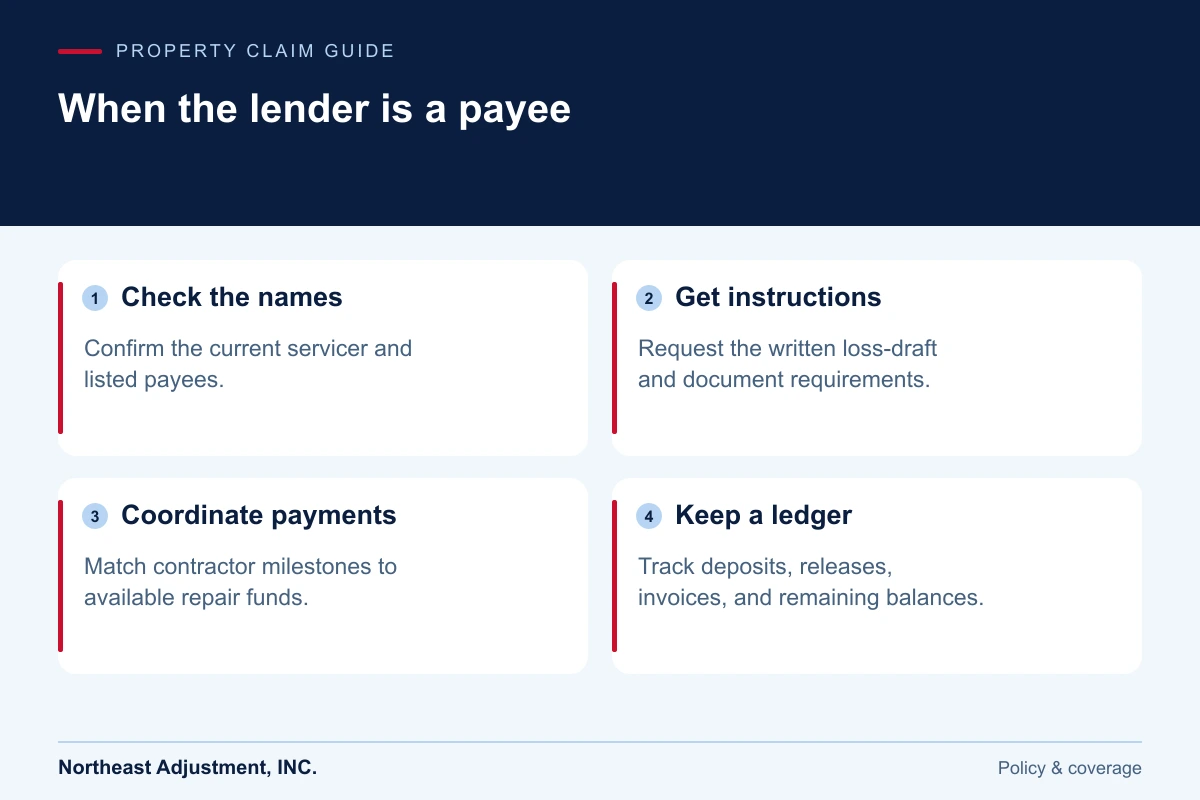
Your mortgage servicer is generally the company receiving your mortgage payments. Its loss-draft or insurance-claims department may handle repair checks separately from ordinary customer service.
Confirm the current servicer using your mortgage statement. If the check names a previous company, a paid-off lender, or a misspelled payee, contact the insurer and servicer about correction. Do not alter the check or try to endorse another party's name.
The Consumer Financial Protection Bureau's disaster guidance explains that mortgage agreements may require jointly payable insurance checks and staged release of funds as repairs progress. Ask how your loan and repair situation will be handled.
Request the full document list
Obtain requirements before mailing an original check or committing to a contractor's payment schedule. Ask about:
- Endorsement and delivery instructions.
- Required estimates, contracts, and claim documents.
- Contractor information or other requested verification.
- Initial disbursement and subsequent payment stages.
- Inspection requirements and how to request them.
- The contact responsible for questions or missing documents.
Keep a copy of everything submitted and use a trackable delivery method when sending important originals. Confirm receipt. A request marked “sent” in your own records is not the same as a complete package accepted by the servicer.
Coordinate the repair schedule
Consider an illustrative Connecticut homeowner repairing a ceiling, insulation, and flooring after a winter water loss. The contractor requests a deposit before ordering materials, while the servicer requires documents before releasing funds.
Share the requirements with the contractor early. Ask which milestones are practical and what documentation the contractor can provide. Avoid assuming that the insurer's check date is the date you can spend the entire amount.
Maintain a simple ledger: insurance proceeds received, money held by the servicer, releases made, contractor invoices, payments, and remaining work. Separate the deductible and any owner-funded improvements. If the project changes, update the ledger and ask whether revised documents are needed.
A clear account helps prevent a common communication problem: several parties using “paid” to mean different things.
Clarify what the check covers
Ask the insurer for a payment explanation identifying the coverage and calculation. Building repairs, belongings, and temporary living costs may be handled differently; do not assume every payment must follow the same release process.
If the contractor finds additional damage, that question returns to the insurer's review of the repair scope. The mortgage servicer does not decide insurance coverage merely because it holds the funds.
Similarly, a lender's inspection may be about repair progress rather than the quality assurance you need from your contractor or local building officials. Ask what each inspection confirms.
Address financial pressure promptly
If displacement or repairs make mortgage payments difficult, contact the servicer before falling behind. Damage does not itself cancel payment obligations. Available assistance depends on the loan and circumstances; obtain any arrangement in writing.
For an unexplained delay, ask which requirement is outstanding, who can resolve it, and how to escalate the request. Keep correspondence and dates. The CFPB and state regulators provide consumer resources when ordinary communication does not resolve a servicing problem.
Common questions
Can I insist that the insurer remove the lender?
Ask why the lender is listed and whether correction is appropriate. Loan documents and the lender's interest matter.
What if I already paid for repairs?
Request the servicer's requirements for completed work and provide invoices, payment records, and any requested inspections.
Should I sign a repair contract immediately?
Understand both its payment obligations and the funding process first. Seek legal advice about contract terms you do not understand.
Our claim library covers related payment records. Contact Northeast Adjustment to discuss the insurance documentation supporting your repair claim.