



A temporary apartment may keep your family close to school, while a hotel may be available sooner. After property damage, those practical decisions can be difficult to make before you understand how additional living expenses are handled. Contact the insurer early and keep a clear record of both the need to relocate and the costs involved.
Heating-related losses provide a seasonal reminder. USFA estimated $488 million in U.S. residential heating-fire property losses during 2023. That figure measures physical property loss, not temporary-housing payments. For a Northeast household displaced during heating season, the recovery file may need to address both. USFA heating-fire estimates
Understand what “additional” means
Additional living expense coverage, often shortened to ALE, can help with increased living costs when a covered loss makes the home unsuitable to occupy. Its terms, limits, and duration depend on the policy.
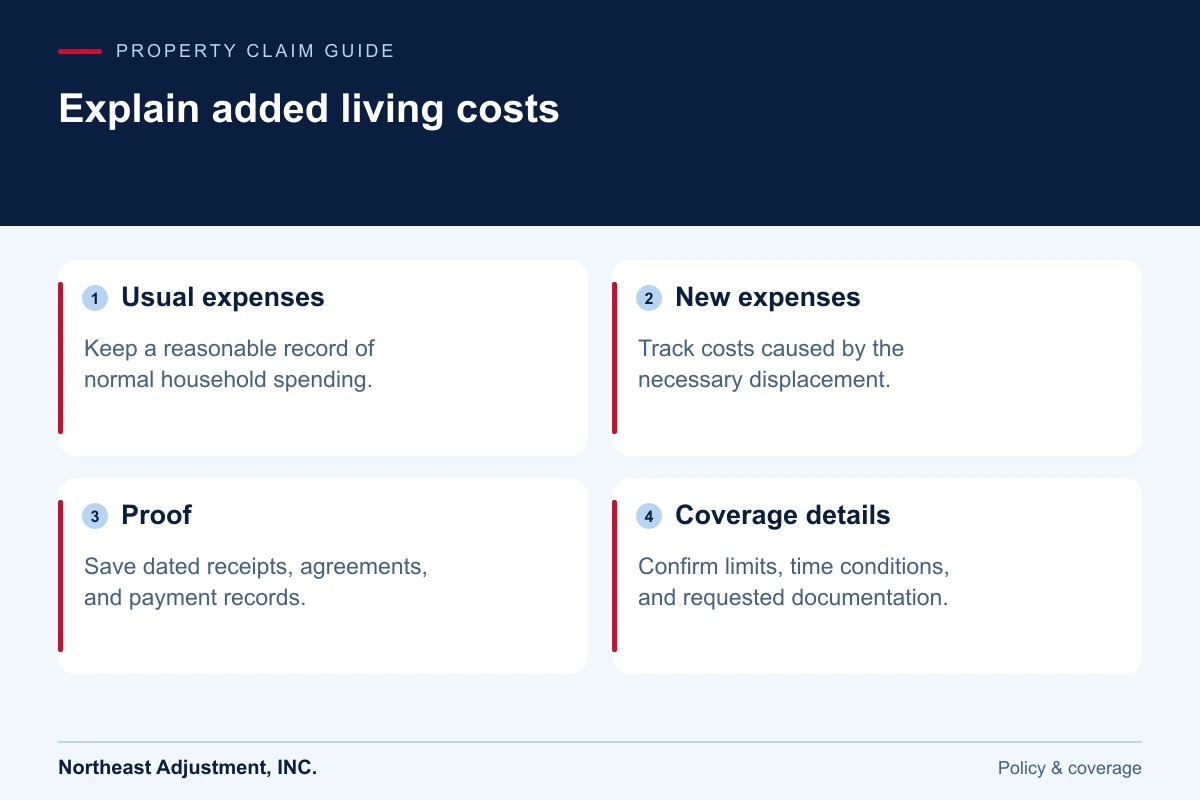
The word “additional” matters. Keep evidence of normal expenses as well as new spending. If you ordinarily buy groceries, a restaurant bill during displacement does not automatically mean the entire bill is an added cost.
Ask how the insurer wants these comparisons presented. Do not assume that every inconvenience or expense will qualify. The New York DFS disaster guidance recommends discussing arrangements with the insurer and retaining expense records.
Describe the household's practical needs
Consider an illustrative Long Island family whose kitchen and nearby living area require repairs after a covered fire. A temporary location affects school transportation, work travel, pets, laundry, and meal preparation.
Explain these needs before committing to a long rental agreement when possible. Ask about available arrangements and documentation requirements. If an immediate safe placement is necessary, record why it was chosen and notify the insurer promptly.
Keep the professional or official findings supporting the decision that the home cannot be occupied safely. A photograph of damage can help, but it may not explain whether utilities, access, sanitation, or other essential functions are available.
Use a running expense record
A simple spreadsheet or notebook can include the date, vendor, category, total, normal-cost comparison if relevant, receipt filename, and reason connected to displacement.
Useful categories may include:
- Temporary accommodation and required deposits.
- Additional meal costs.
- Laundry when household facilities are unavailable.
- Storage or moving costs being considered under the claim.
- Added transportation costs.
- Other expenses specifically discussed with the insurer.
List an item even if its treatment remains unresolved, but mark that status clearly. Do not label a questioned expense “approved” because you submitted it.
An illustrative cost comparison
Suppose a household normally spends $180 a week on groceries and documents $290 in meal spending while it has no kitchen. The $110 difference is a starting point for explaining an increase, not a promise that the policy pays that amount.
Actual treatment may depend on what was purchased, available cooking facilities, the insurer's requirements, and policy terms. Save the underlying receipts rather than submitting only the arithmetic.
Likewise, separate a refundable deposit from a final expense. Note refunds, credits, canceled reservations, and any amount paid directly by an insurer or housing vendor. This helps avoid duplicate reimbursement requests.
Track time as carefully as money
Keep repair schedules, access updates, contractor communications, and reasons for delays. Ask how the policy's time conditions apply and when the insurer needs an update on temporary housing.
If a rental must be extended, raise the issue before the current arrangement ends. Provide the latest repair information and the proposed cost. Do not wait until checkout day to discover that the extension has not been discussed.
A repair delay does not automatically extend every policy benefit. Request a written explanation if the insurer and contractor disagree about the necessary duration.
Common questions
Does a power outage alone trigger ALE?
Not necessarily. Review the cause, damage, and policy. Loss of electricity and covered damage making the home uninhabitable can be different situations.
Can I stay with family?
Ask what reasonable additional expenses, if any, may be considered and what records are required. Do not invent rental charges.
Should I keep small receipts?
Yes. Clear records of modest expenses can be easier to assemble daily than reconstruct later.
Our claim resources cover related recovery paperwork. Contact Northeast Adjustment to discuss how to organize displacement records and the questions to raise about your property claim.