



A restoration agreement may be handed to you while a ceiling is wet or smoke cleanup is urgently needed. You can arrange necessary protective work while still asking what the document authorizes. Start with the scope, pricing method, and your payment obligations.
The stakes can extend well beyond a small service call. USFA estimated $572.7 million in U.S. residential cooking-fire property losses in 2023. This national loss estimate is not a contractor-price benchmark, but it shows why a kitchen incident can lead to substantial restoration decisions. USFA cooking-fire data
What work am I authorizing?
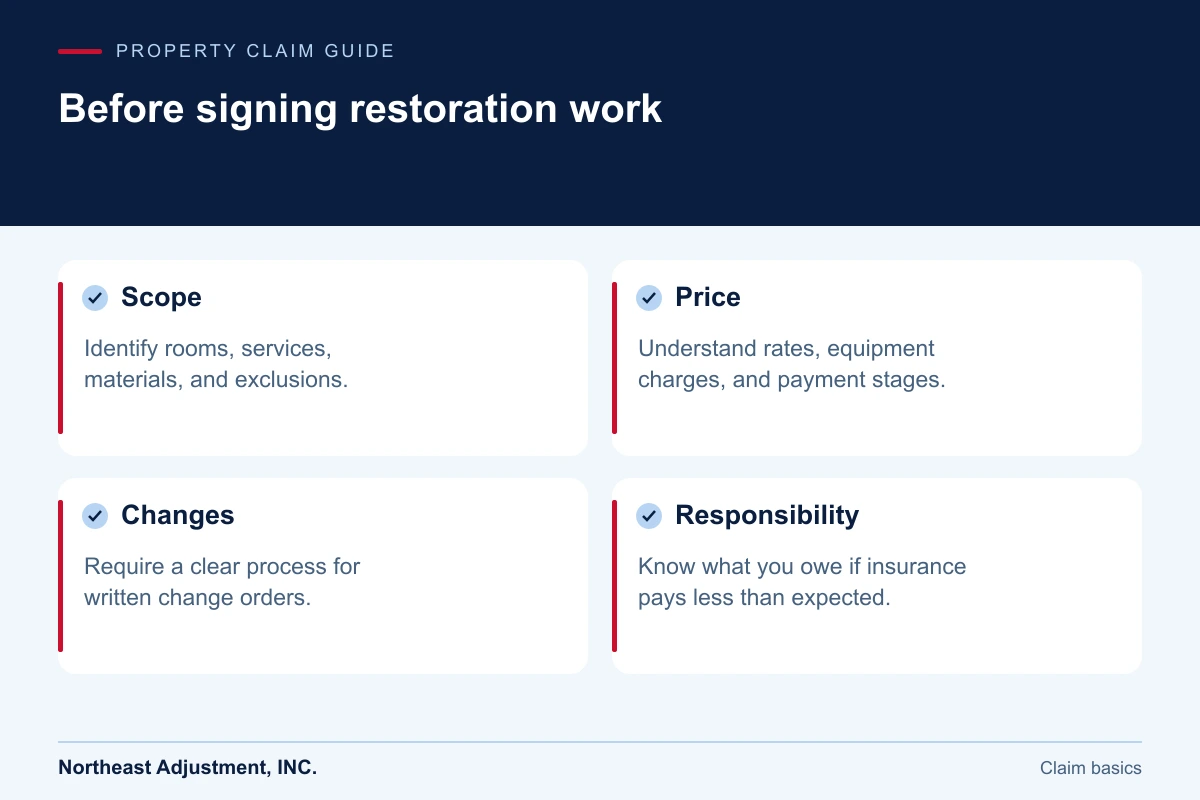
Ask whether the agreement covers emergency stabilization, drying, cleaning, contents handling, demolition, storage, permanent repairs, or a combination. Identify the rooms and materials involved.
In an illustrative Queens kitchen fire, a contractor may initially remove water and secure the area. Rebuilding cabinets, storing belongings, and repainting adjoining rooms are additional tasks. The authorization should make clear which tasks are included now and which require another decision.
Look for exclusions as well as included services. If specialty testing, hazardous-material work, permits, or another trade is outside the price, ask how it will be handled. Do not assume a general promise to “restore the home” answers every practical question.
How is the price calculated?
Find out whether the agreement uses a fixed amount, unit rates, time and materials, equipment charges, or another method. Ask what documents will show the actual work.
The Federal Trade Commission's contractor guidance recommends written estimates and careful contract review. Compare proposals by scope and terms, not only the final number.
For equipment-based work, ask about placement, monitoring, operating days, and removal. For storage, ask when charges start and end, how contents are inventoried, and how delivery back to the home is arranged.
What happens when the scope changes?
Hidden damage may appear after work begins. Ask for a process that explains the new finding, proposed work, cost, and authorization before nonemergency changes proceed.
A useful change order identifies the original agreement, affected location, added or removed work, price adjustment, and scheduling effect. Keep photos and findings that support it.
Avoid relying on an informal conversation when the cost or scope materially changes. A brief written confirmation gives everyone the same reference point.
Who pays if insurance does not cover everything?
Read the payment language closely. A contractor's statement that it will “work with insurance” does not necessarily mean you owe nothing beyond the deductible.
Ask who is responsible for questioned charges, excluded work, upgrades, deposits, and amounts above limits. Understand when payment becomes due relative to insurance decisions and mortgage-servicer releases.
If the document includes an assignment, direction to pay, lien-related language, financing, or a release you do not understand, get appropriate legal advice before agreeing. These provisions can have consequences beyond approving a cleanup visit.
Never sign blank sections or inaccurate completion statements. Keep the full signed agreement, including attachments and any terms supplied on a separate page.
Who will perform and document the work?
Confirm the business identity and applicable licensing or registration requirements. Ask for insurance information, references, and the name of the project contact. Check credentials through the appropriate authority rather than relying only on a logo or business card.
Ask whether subcontractors will be used and who coordinates access, inspections, and updates. Clarify how you will receive photographs, inventories, moisture records, invoices, and warranty information.
For an occupied Northeast home, discuss practical access and protection of unaffected areas. If work requires moving belongings, record who controls the inventory and where those items will go.
Before the final signature
Read the agreement in a calm setting if possible. Separate urgent safety measures from decisions that can wait for a defined estimate. Ask for unclear terms to be explained in writing.
Must I use the insurer's suggested contractor?
Ask about your options and any program terms. Do not confuse a recommendation with a universal requirement.
Is the lowest price always the best choice?
No. Missing work, unclear quantities, and different payment terms can make prices difficult to compare.
Find more repair-documentation guidance in our claim articles. Contact Northeast Adjustment to discuss how the restoration scope and supporting records relate to your property claim.