


Opening the refrigerator after an outage raises two separate questions: what food is safe, and whether the policy addresses any loss. Make the safety decision first. Do not taste questionable food or keep unsafe items merely because an insurer has not inspected them.
Winter outages are a practical Northeast concern. NOAA counted 21 billion-dollar winter-storm events affecting New York during 1980–2024. Each qualified on total U.S. losses, not New York damage alone. That historical record does not measure food-spoilage claims, but it provides context for including refrigeration in a storm plan. NOAA New York summary
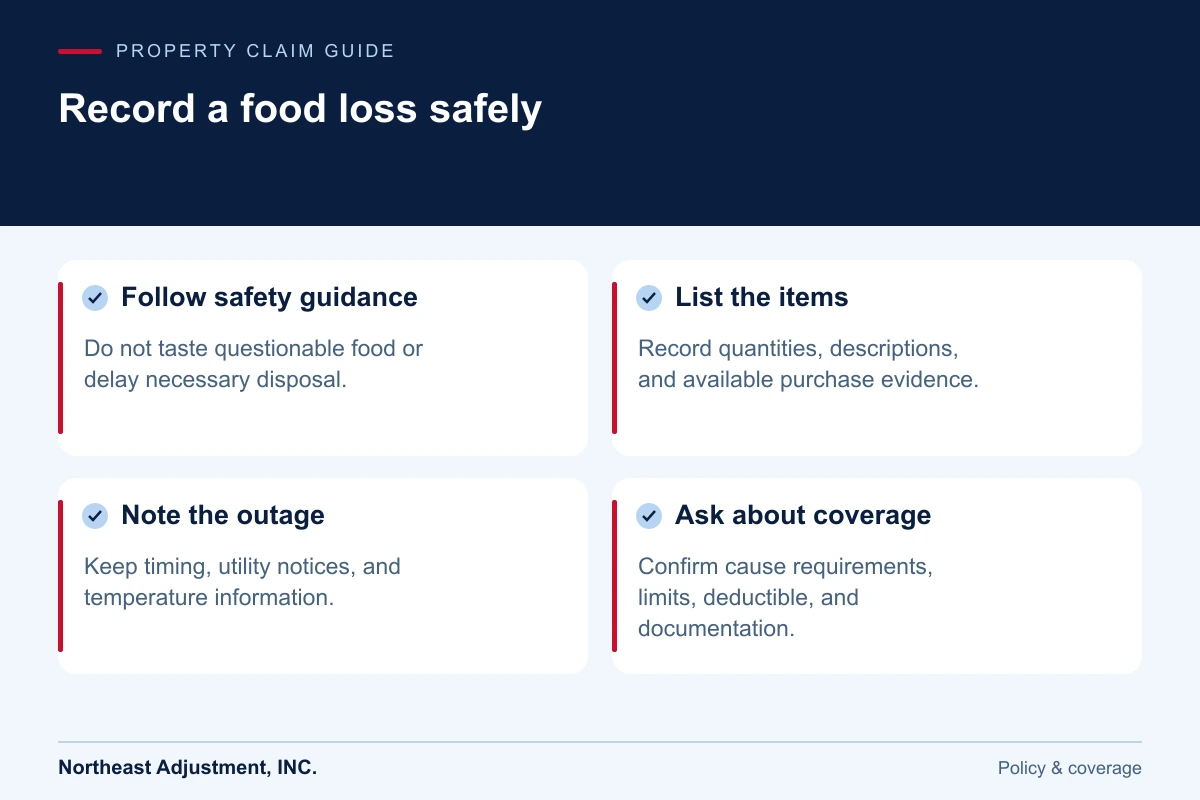
Follow food-safety guidance
The FDA's outage guidance says an unopened refrigerator keeps food cold for about four hours. A closed full freezer can hold temperature for approximately 48 hours, or 24 hours if half full.
Those are practical approximate guidelines, not insurance rules or guarantees for every appliance. Temperature, how often doors opened, and other conditions matter. Follow the FDA's instructions for evaluating and discarding food; appearance and smell alone are not reliable tests.
If food touched floodwater, that creates additional safety concerns. Use the appropriate guidance rather than treating flood exposure as an ordinary electrical outage.
Record items without extending the hazard
Consider an illustrative New Jersey household returning after a prolonged storm outage. Before safe disposal, the homeowner photographs package labels and groups of items, then makes a list of what was lost.
Record descriptions and quantities clearly: packages, containers, or approximate weights where known. Avoid a single entry such as “everything in freezer” with no explanation.
Useful details include:
- Item name and brand when relevant.
- Quantity or package size.
- Available purchase price or reasonable supporting record.
- Whether it was refrigerated or frozen.
- Photographs associated with the item.
- Date and reason for disposal.
Do not invent exact purchase prices or pretend to remember every item. Identify estimates honestly and ask the insurer what supporting evidence it accepts.
Keep the outage and temperature information
Save utility notifications, outage-report confirmations, restoration messages, and any appliance-monitoring records. Note when you first learned power was lost and when it returned.
If the exact start time is unknown, say so. A utility's neighborhood notice may provide context without proving the precise conditions inside your refrigerator.
Record thermometer readings that actually exist. Do not create a retrospective temperature log. If a door was left open or an appliance was already malfunctioning, describe the facts accurately because cause can matter.
For a household that used ice, a cooler, or another safe storage arrangement, keep related receipts and note which food was preserved. The inventory should include actual losses, not items that remained usable.
Ask the insurer focused questions
Spoilage coverage varies. Ask whether the policy addresses the cause of this outage, whether a separate limit or deductible applies, and what documentation is required.
A power interruption away from the home, equipment breakdown, direct storm damage, and a household appliance failure may be treated differently. Do not assume that “food spoiled” identifies the coverage trigger.
Ask whether a separate food claim affects any other part of an existing property claim and how the insurer wants the records submitted. Keep the payment explanation so you can understand any amount allowed or declined.
Separate household and business food
If the home also contains stock for a food business, identify it separately. A homeowners policy may not handle business property in the same way as household groceries.
Commercial operators should follow their applicable health-authority requirements and business policy. The household guidance here is not a substitute for commercial temperature-control or disposal rules.
Common questions
What if I already threw the food away?
Gather the records you have, including photos, purchase histories, and an honest item list. Explain why disposal occurred.
Do I need receipts for every item?
Ask what alternatives are accepted. Available purchase history and photographs can still be useful.
Can I claim the entire grocery bill?
Identify the items actually lost and avoid including unaffected purchases.
Our storm and claim articles cover related documentation. Contact Northeast Adjustment to discuss how the outage and loss records fit a property-insurance claim.