


When a manager finds water entering a stockroom before opening, the first few calls should not depend on memory. A business emergency list should identify the right people, their roles, backups, and how they can access the building or records.
SBA's 2025 New York profile reports about 3.9 million small-business employees, using underlying 2022 Census business data. The figure is not a disaster statistic, but it shows why property response affects staff as well as buildings and inventory. SBA New York profile
Build the list around decisions
Instead of alphabetizing every vendor, group contacts by the decision needed.
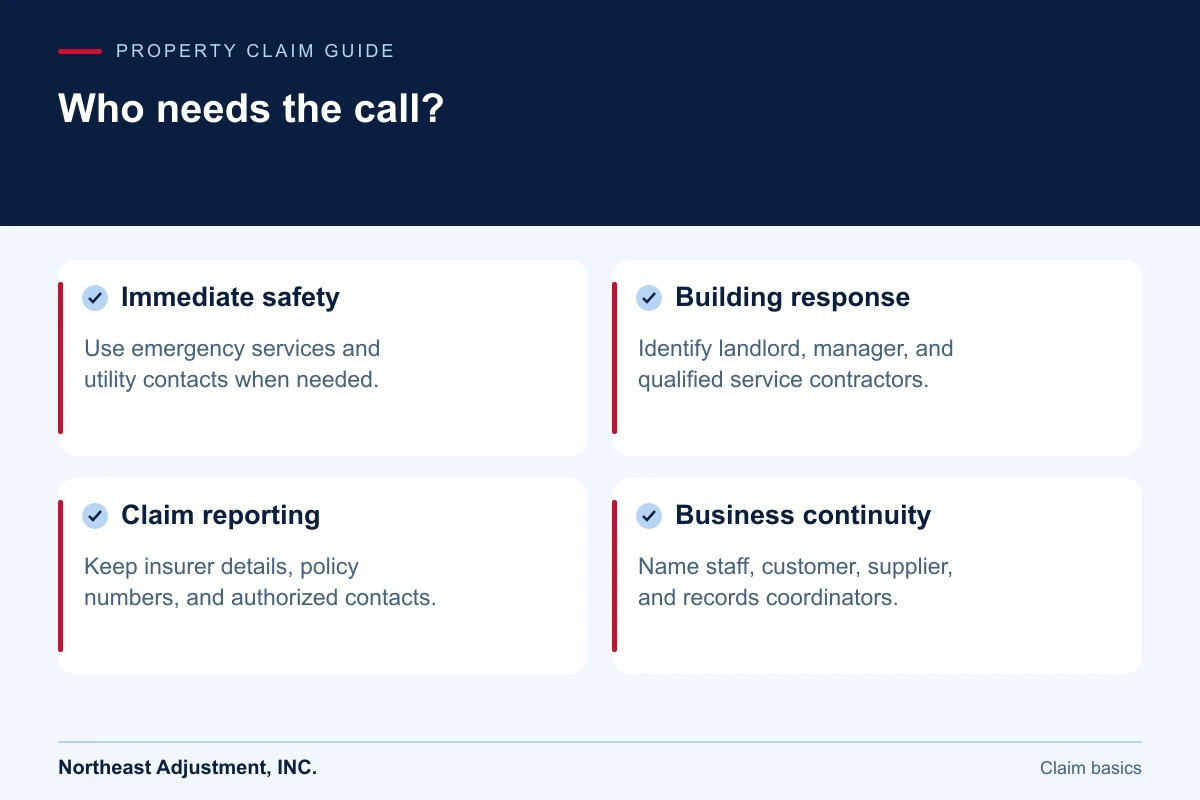
Immediate safety: Emergency services, the relevant utility, and building emergency procedures. An insurance conversation should not delay an urgent safety response.
Building systems: Landlord or property manager, plumber, heating contractor, electrician, and other qualified service contacts.
Claim reporting: Insurer reporting channels, policy details, broker or agent, and any claim representative already engaged.
Business continuity: The people responsible for employees, customers, suppliers, accounting, and access to important records.
A short description beside each name helps an unfamiliar backup make the right call.
Identify who can authorize work
Consider an illustrative Connecticut retailer whose owner is traveling over Thanksgiving. The opening manager can contact the landlord, but nobody has stated who may authorize emergency water removal.
Resolve that before an incident. Set practical internal authority for necessary stabilization, and explain when the owner or another decision-maker must be involved. Do not confuse permission to arrange work with a guarantee of insurance reimbursement.
Record who holds keys or access credentials, who can meet responders, and which areas require building-management access. Protect sensitive credentials; the general contact sheet can refer to a secure access method.
Add backups and after-hours details
A single office number is not enough when a problem happens before opening or during a holiday. Confirm the appropriate emergency channel and backup contact for important services.
Include:
- Name, role, and organization.
- Primary and after-hours contact methods.
- Backup person or service.
- What the contact is responsible for.
- Access or authorization limitations.
- Date the information was verified.
Ask vendors how emergency requests are handled and whether your business needs to establish an account beforehand. Do not assume a contractor who performed routine work can always respond immediately.
Keep claim information available offsite
The NAIC's small-business guidance emphasizes maintaining business and insurance records. Store the policy, property schedule, inventory, and necessary financial information so authorized people can access them if the premises are unavailable.
Keep the insurer's reporting information current and distinguish a policy number from an old claim number. If several locations or policies exist, identify which applies to each premises.
A manager reporting damage should provide accurate observations, the address, contact details, and immediate actions taken. They should not guess the cause or promise that the whole business is closed if some operations continue.
Plan accurate staff and customer updates
Name one person to confirm operating status and another to distribute the message if that person is unavailable. Decide which communication channels employees and customers should check.
Do not publish a reopening time before the building and required systems are evaluated. An initial update can explain that the premises are being assessed and state when more information is expected.
Keep supplier communication focused on the actual disruption: delayed deliveries, alternate receiving arrangements, or affected orders. Save records of changes that may later help explain business interruption.
Test the list with a short scenario
Walk through a hypothetical discovery before business hours. Ask who answers, who has access, who authorizes work, and who records the event. Identify gaps without staging a real emergency or calling emergency services for a test.
Update the list after staff changes, lease changes, new equipment, or a move. Keep a dated printed copy in a useful location and a secure digital copy elsewhere.
Common questions
Should every employee see the full list?
Share the information each role needs. Sensitive financial details and access credentials require appropriate controls.
Does calling my agent replace reporting to the insurer?
Confirm that the claim has actually been reported and obtain the claim number. Reporting arrangements vary.
What belongs in the first incident note?
Discovery time, observed conditions, safety actions, people contacted, and supporting photos when safe.
Find more preparation guidance in our business claim articles. Contact Northeast Adjustment to discuss the records and coordination needed after property damage affects your business.