



A roof tarp is temporary protection, and its claim record should explain why it was needed, where it was installed, and what the contractor did. That information can be lost when an urgent visit produces only a short receipt.
NOAA recorded 48 billion-dollar severe-storm events affecting New York during 1980–2024. NOAA National Centers for Environmental Information This threshold applies to each event's U.S. losses. The historical count provides context for storm preparation in New York. It does not show that any particular tarping expense is covered or reasonable. The work at your building needs its own location-specific explanation.
Choose safe documentation over roof access
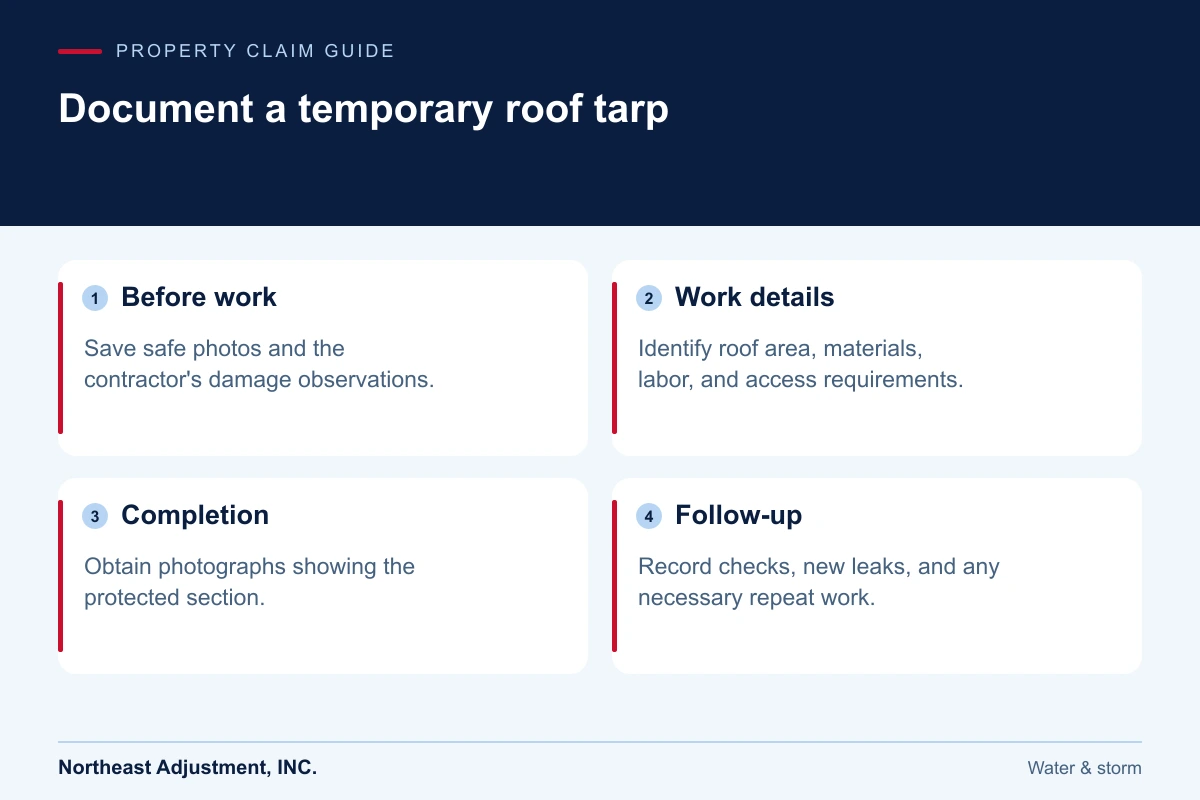
Do not climb onto a damaged, wet, or steep roof to photograph it. Use safe ground views and indoor observations, then ask the qualified contractor for roof-level images.
Before work, request pictures of the affected area if conditions permit. Ask the contractor to identify visible openings or damage and explain why temporary protection is necessary. If weather or safety prevents detailed photographs, record that limitation.
Report the loss promptly and tell the insurer that emergency protection is being arranged. Connecticut's post-disaster claims guide discusses protecting damaged property and keeping emergency-repair receipts. Necessary safe protection should not wait solely for a routine inspection.
Put the work location in writing
Ask the contractor to identify the roof slope, section, or addition being protected. A sketch or annotated copy of a photograph can clarify the area, while the original image should remain unchanged.
The scope should describe the materials, labor, access requirements, and any associated tasks. If damaged material must be moved, ask what was removed and why. Keep those details distinct from a proposed permanent roof replacement.
Read the authorization before signing. Clarify whether it is for temporary protection alone, how charges are calculated, and whether any ongoing service is included.
Your tarping record checklist
- Safe before-work photographs or a written explanation of access limits.
- The contractor's observations and reason for urgent protection.
- The location, dimensions if measured, materials, and work date.
- An itemized invoice and proof of payment.
- Completion photographs showing the protected area.
- Instructions about monitoring, limits, and follow-up contact.
A weather forecast screenshot may explain urgency, but it does not replace evidence of the roof's condition. Similarly, a large tarp does not prove that the entire covered roof section requires replacement.
Follow the temporary protection afterward
Ask the contractor what signs require a return visit and how to report concerns. Record new interior leaks by location and time. Do not adjust fasteners or move the tarp yourself if doing so requires unsafe access.
If another visit is needed, request a separate explanation of what changed and what work was performed. Link repeat invoices to the earlier work so the reviewer can understand the sequence.
Temporary protection is not a guarantee against all weather or an indefinite substitute for repair. Arrange the permanent assessment and coordinate inspections while monitoring conditions appropriately.
A flat-roof addition example
Imagine, hypothetically, that a Queens homeowner has damage near the junction of a rear addition and the main building. An emergency contractor protects a defined section and provides dated photographs.
The owner keeps that invoice separate from the roofer's later proposal. When the permanent scope is reviewed, the photographs show what was visible before the tarp concealed the area. If more damage is found after removal, the owner can compare it with the earlier record.
Coverage, price, and the necessary repair area still depend on the actual evidence and policy. The example illustrates organization, not an approval outcome.
Common questions
Will insurance reimburse any emergency tarping bill?
No automatic reimbursement should be assumed. Ask about applicable coverage and preserve a clear, itemized description of necessary work.
Must I use a roofer suggested by the insurer?
Ask about contractor selection and any program terms. Review the contractor's qualifications, contract, and scope independently.
Can the tarp come off for inspection?
Coordinate that decision with the contractor and insurer so access is safe and the building remains appropriately protected. Do not remove it yourself just to obtain photographs.
Read roof-leak documentation before repairs for the broader evidence package. For help presenting temporary protection and repair records, contact Northeast Adjustment.