



Water appearing near a roof edge or basement wall can lead to a quick conclusion: the gutters must be clogged, or the storm must have damaged them. Either explanation may be incomplete. A useful investigation looks at drainage condition, physical damage, the water's path, and the property's history.
The Fifth National Climate Assessment shows a 60% increase in Northeast precipitation falling on the heaviest 1% of days over 1958–2021. U.S. Global Change Research Program; NOAA-hosted copy This regional finding concerns heavy-day precipitation over a historical period. It does not show that a particular gutter was overwhelmed, damaged, or poorly maintained. Those are property-specific questions that need observations and professional findings.
Start with the actual symptoms
Record where the leak appeared and when it was discovered. Photograph the interior area and accessible exterior features. Note whether you observed overflowing water during the event or only found stains afterward.
Avoid turning an inference into a fact. “Water was spilling over this edge at 4 p.m.” is an observation. “The storm broke the gutter” requires supporting physical evidence.
Stay on the ground for your own exterior survey. Wet ladders, roof edges, and damaged drainage components create avoidable risks. Ask a qualified contractor for close photographs where access is needed.
Ask what the inspection found
A report can identify debris, disconnected joints, displaced sections, damaged fasteners, or other observed conditions. It should also explain how those findings may relate to the leak and where the cause remains uncertain.
Ask whether nearby flashing, roof coverings, wall details, window wells, and ground drainage were considered where relevant. Water at a basement wall may have a different route from water behind fascia at the roof.
New Jersey's storm claim guidance encourages documentation and questions about the insurer's coverage explanation. A clear cause report helps keep that discussion specific.
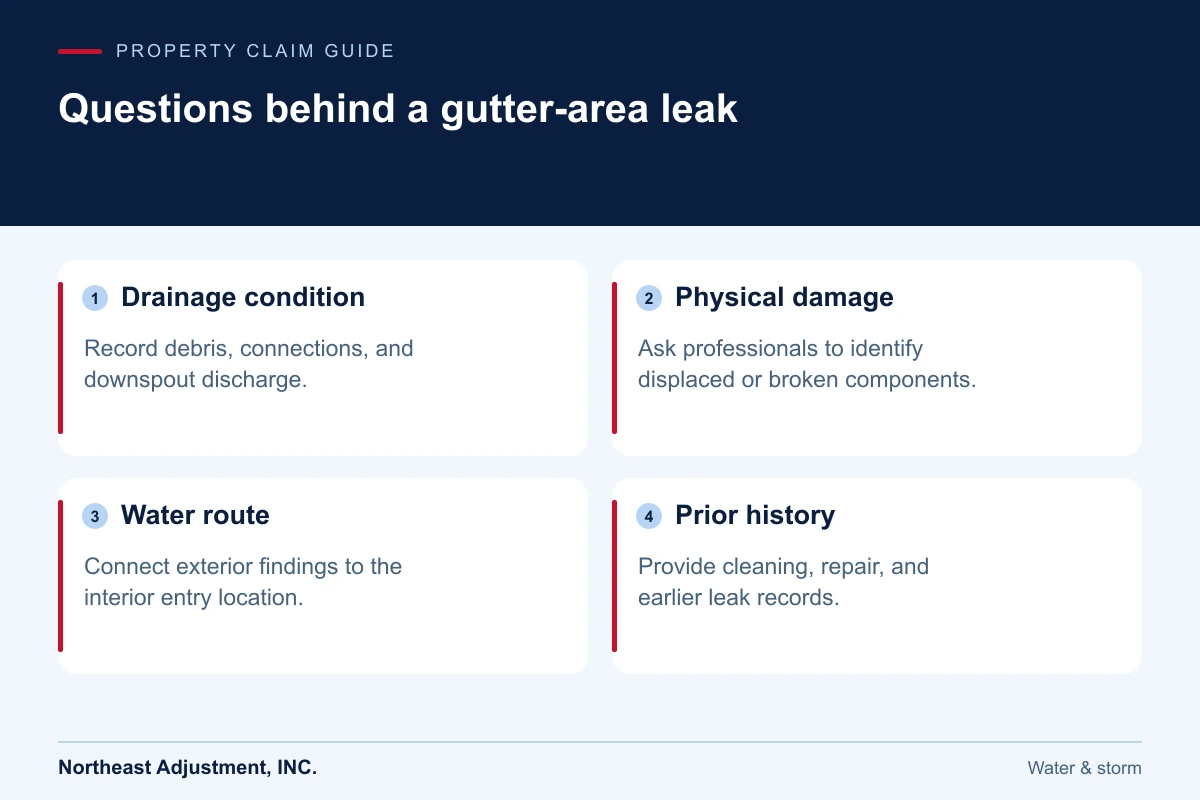
A focused evidence checklist
- Dated photos of accessible gutters, downspout connections, and discharge points.
- Interior photos showing the exact leak location.
- Cleaning and repair invoices, including work dates and areas serviced.
- Contractor findings about physical damage and the likely water route.
- Earlier leak records or photographs showing prior condition.
Maintenance records should be accurate, including known unresolved concerns. Cleaning a gutter shortly before a storm does not prove every component was sound, and debris found afterward does not by itself establish the entire cause of interior damage.
Keep upkeep and loss repair separate
If a contractor performs routine cleaning and repairs a damaged section during the same visit, request separate descriptions. The insurer can then distinguish upkeep from the work alleged to address the reported loss.
Ask about policy language concerning wear, maintenance, and resulting damage. Coverage cannot be determined solely by using the word “storm” or “clog.” The actual cause and contract provisions govern.
If several factors appear involved, preserve the full assessment. Do not omit a contractor's findings because they complicate the story. An accurate record is more useful than a simplified one.
One rainstorm, two observations
Suppose a Pennsylvania homeowner, in a hypothetical example, sees water spill from a gutter corner during heavy rain and later finds dampness near a basement window. A contractor documents leaves at a junction and a downspout outlet close to the window well.
The owner asks how those observations connect and whether other entry routes need inspection. The report may support a drainage explanation, identify additional issues, or leave questions open. The homeowner does not assume that the timing alone proves insured storm damage.
This approach also helps plan the right repair. Fixing the visible interior stain without resolving the water route may leave the underlying problem unanswered.
Common questions
Does a recent gutter cleaning prove the leak was storm damage?
No. It is useful history, but the current findings and actual cause still matter.
Should I clean debris before an inspection?
Arrange necessary safe protection and maintenance, while documenting conditions first when practical. Ask the insurer about evidence needs, and retain the contractor's record.
Can the insurer deny a claim just by calling it maintenance?
Ask for a written explanation identifying the facts and policy language relied on. Provide accurate contrary evidence if you have it.
Our wind-driven rain and floodwater guide explains another cause distinction. Contact Northeast Adjustment for help organizing the record of a water loss.