



A deductible is the part of a covered loss you are responsible for under the applicable policy provision. It affects the payment calculation, but it is not the same as depreciation, a coverage limit, or work the insurer finds outside the policy.
Repair costs can be substantial, which makes the details worth understanding. State Farm's average freeze-related water-damage claim payment exceeded $30,000 for 2024 through June 2025. State Farm This historical single-insurer average does not estimate your recovery. That figure reflects State Farm's United States claims experience for several types of freeze-related water damage. It does not establish the deductible, covered amount, or payment for your home.
Find the deductible that applies
Start with the declarations page, then read the relevant policy forms and endorsements. Some policies use a fixed dollar deductible. Others include separate provisions for particular events, which may use a percentage.
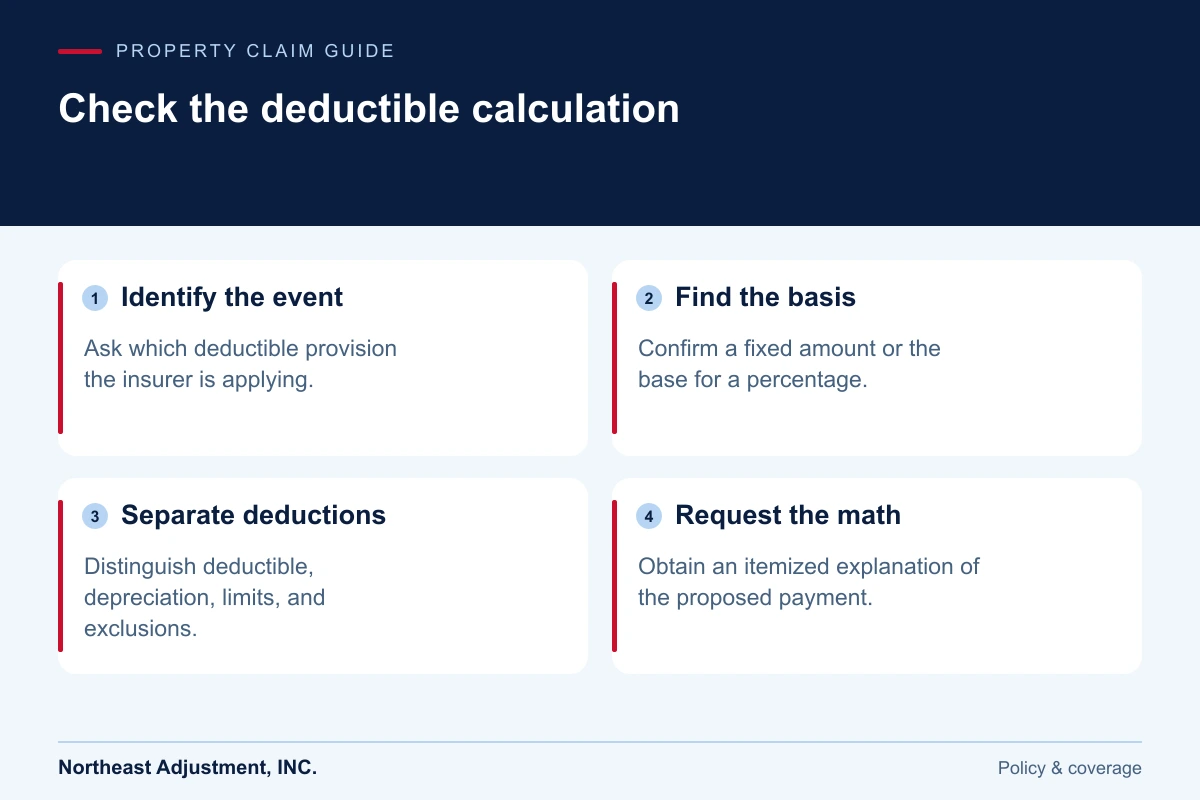
Ask the insurer to identify the provision it is applying and why. The event's description matters: a wind deductible and a hurricane deductible may have different triggers. Do not assume that the word “storm” selects the correct one.
The Connecticut Insurance Department's post-disaster guide explains deductible and valuation concepts. Your own contract provides the actual amounts and conditions.
Understand the calculation base
For a fixed deductible, the amount is stated in dollars. For a percentage deductible, ask what amount is multiplied by that percentage. It may be a specified insured value rather than the repair invoice.
Here is a deliberately simplified, illustrative example: assume an otherwise payable loss of $10,000 and an applicable fixed deductible of $1,000, with no other adjustments. Subtracting that deductible leaves $9,000. Those numbers are examples, not typical limits or a forecast of any claim.
For a percentage provision, write out the base and percentage before doing the arithmetic. Do not use the property's sale price, mortgage balance, or repair cost unless the policy identifies that as the correct basis.
Read the full payment explanation
The insurer's estimate or letter may show replacement cost, depreciation, actual cash value, deductible, prior payments, and other adjustments. These entries should not be collapsed into a single unexplained deduction.
Ask for an itemized explanation if you cannot follow the math. Clarify whether a listed amount has already been applied and whether a payment relates to the building, contents, or another portion of the claim.
A contractor's invoice does not automatically change the deductible. Similarly, a contractor's promise to “handle” it is not a substitute for understanding your obligations and accurately documenting the transaction.
Questions for your claim file
- Which deductible provision applies to this event?
- Is it a fixed amount or a percentage, and what is the stated base?
- How is the insurer treating separate dates or events?
- Which other adjustments appear in the calculation?
- Are earlier payments already included in the displayed total?
Save the written answers. If your question concerns a policy interpretation rather than arithmetic, identify the exact language involved so the response addresses the issue.
When one storm affects several areas
Imagine a coastal New Jersey homeowner has roof and interior damage after the same reported storm. In this hypothetical situation, the owner receives separate estimate sections for the roof and living room and wonders whether each section means a new deductible.
The owner asks how the policy defines and applies the deductible to the reported event. Separate estimate pages do not answer that question by themselves. The facts and policy determine the treatment; neither one deductible nor several should be assumed without review.
Common questions
Do I send my deductible to the insurer?
Ask how the claim payment and contractor payment will be handled. In many situations it is reflected in the amount the insurer pays rather than a separate payment to the carrier.
What if the repair cost is below the deductible?
The calculation may leave no payment for that loss. Report and coverage questions still depend on the actual circumstances and policy duties.
Is depreciation another deductible?
No. Depreciation concerns valuation and may have different treatment under the policy.
Start with reading your declarations page. If a property claim calculation needs a closer review, contact Northeast Adjustment.