


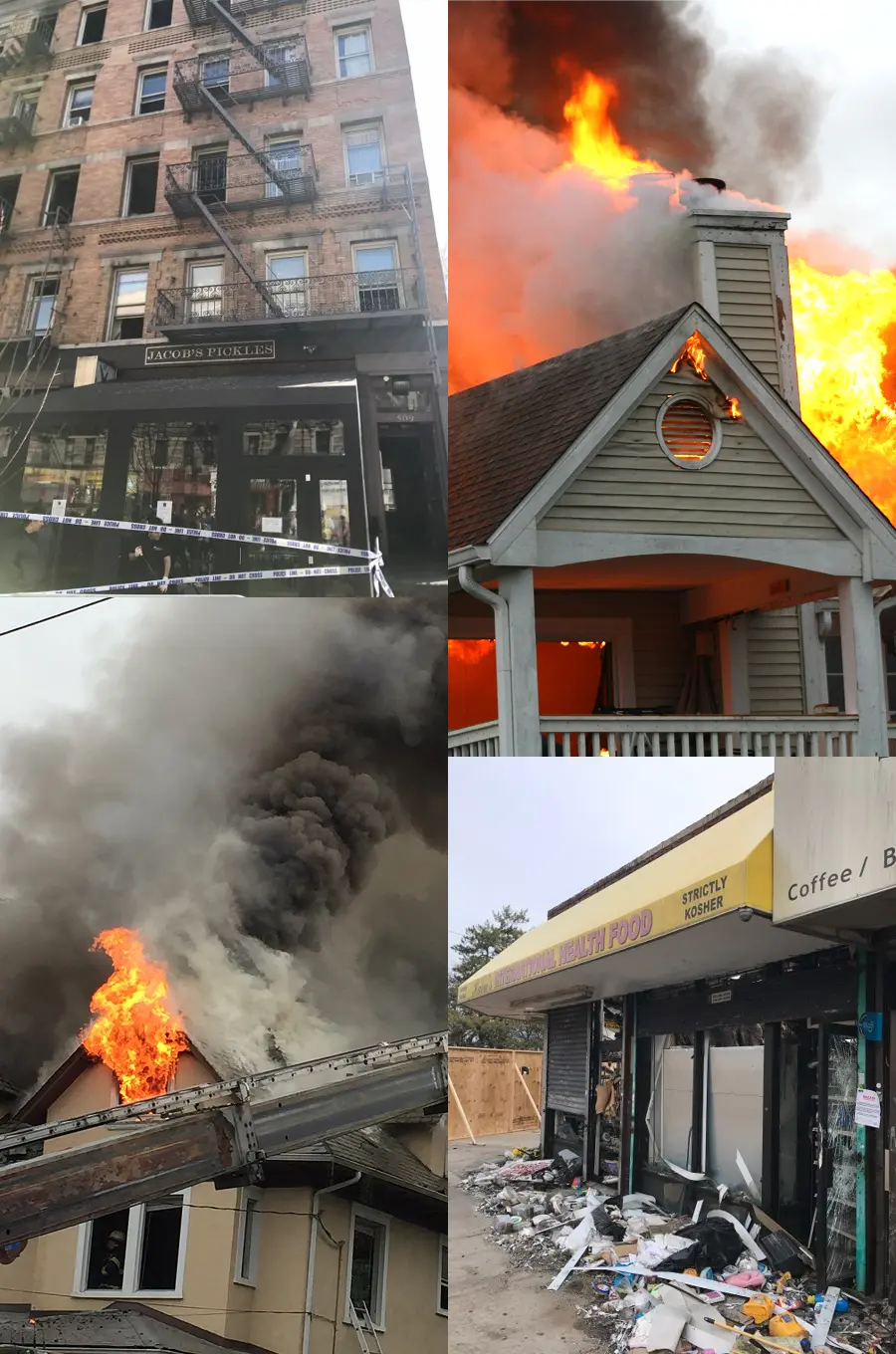
A house fire is one of the most disorienting losses a property owner can face. In the first 48 hours you will be dealing with the FDNY, the Department of Buildings, your family's immediate needs, and an insurance claim that can easily reach six figures. What you do (and don't do) in the first days has a direct effect on your final settlement.
This guide walks through the fire claim process step by step for New York City homeowners and building owners.
Step 1: Make safety and legal notifications first
- Do not re-enter the building until the FDNY or a structural engineer says it is safe. Fire-weakened joists and contaminated air are real hazards.
- If the building is a multi-family or commercial property, the NYC Department of Buildings may issue a vacate order or require a structural assessment before any work begins.
- Get a copy of the fire incident report from the FDNY. Your insurer will ask for it, and it establishes the official cause and origin.
Step 2: Notify your insurer, carefully
Your policy requires prompt notice of the loss, so report the fire quickly. Keep the first call factual: the date, the location, and what you know about the fire. Avoid guessing about its cause or the full repair cost. Review your policy's cooperation requirements when responding to requests for documents or statements: New York's standard fire policy includes examination-under-oath and document-production duties.
Under New York's Regulation 64 (11 NYCRR 216), insurers generally must acknowledge a claim within 15 business days and establish procedures to begin investigating within the same window. Log every call and keep every letter so you can show when notice was given.
Step 3: Secure the property (it's your duty, and your money)
Nearly every policy requires you to protect the property from further damage. In practice that means:
- Board-up of windows, doors, and roof openings
- Temporary fencing if the building is exposed
- Water extraction: firefighting water often causes as much damage as the flames
- Shutting down compromised electrical and gas service
Keep every receipt. Reasonable emergency protection costs are generally reimbursable under the policy, and failing to secure the building can give the insurer grounds to deny the portion of damage that happens afterward.
Step 4: Document everything before anything is moved
The single most common reason fire settlements come in low is thin documentation. Before cleanup:
- Photograph and video every room, including closets, mechanicals, and the roof
- Inventory damaged contents item by item: brand, age, and replacement cost
- Do not throw anything away until the insurer's adjuster has inspected it (or has waived inspection in writing)
- Save samples of damaged materials (flooring, cabinetry) where practical
Smoke and soot damage deserves special attention: it travels far beyond the burn area, corrodes electronics and metals, and is routinely underscoped in insurer estimates. So is the water damage from suppression. See our water damage claims page for how those losses are valued.
Step 5: Understand what you're owed
A NYC homeowners or building policy may cover several distinct categories. Check which apply under your policy and its endorsements:
- Dwelling/building: the structure itself, at replacement cost or actual cash value depending on your policy
- Contents: furniture, clothing, electronics, inventory
- Loss of use / additional living expenses (ALE): hotel and rental costs while your home is uninhabitable
- Loss of rents: if you own a rental property and units are out of service
- Code upgrades (ordinance or law coverage): in NYC, older buildings often can't legally be rebuilt as they were; check whether your policy includes coverage for required upgrades and what limits apply
Step 6: Scrutinize the insurer's estimate before accepting anything
The insurance company's adjuster works for the insurance company. Their estimate is an opening position, not a final answer. Common gaps in fire claim estimates include smoke remediation beyond the burn rooms, electrical and HVAC contamination, code-required upgrades, and matching (replacing undamaged sections so repairs aren't visibly mismatched).
You have the right to hire your own representation. In New York, licensed public adjusters work for the policyholder. Their total fee is capped at 12.5% of the full claim payment; New York's public-adjuster regulation permits a higher percentage on certain supplemental claims only within that overall cap. On significant fire losses, independent scoping of the damage can identify covered items the initial estimate missed.
Step 7: Watch the deadlines
- For a sworn proof of loss, New York Insurance Law § 3407 generally gives you 60 days after receiving the insurer's written demand and suitable forms, or a longer period stated in the demand.
- New York's standard fire policy sets a two-year suit limitation measured from the loss. Check your policy's exact suit limitation clause.
- After receiving a properly executed proof of loss and all requested information, the insurer generally has 15 business days to accept or reject the claim in writing, or explain why it needs more time under Regulation 64, § 216.6.
When to bring in help
If the loss is small and the insurer's estimate looks complete, you may not need anyone. But if the fire displaced you, damaged the structure, involved smoke spread through the building, or the insurer's number doesn't come close to contractor bids, a public adjuster levels the field. Northeast Adjustment, INC. handles fire damage claims throughout the five boroughs (with adjusters who speak English, Spanish, Mandarin, and Cantonese) and offers a free claim review before you sign anything.